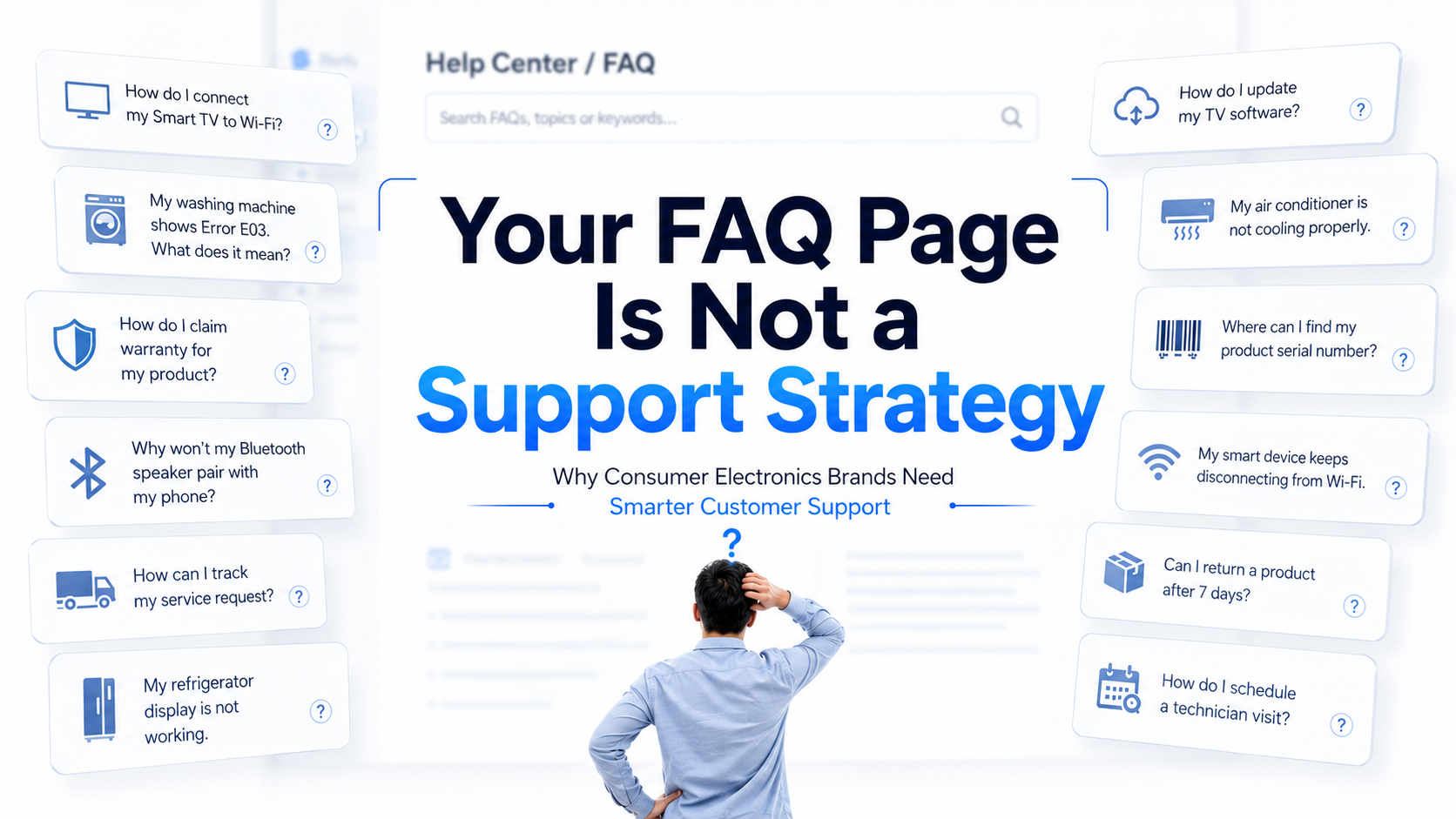
Your FAQ Page Is Not a Support Strategy
Why the era of static self-service is over — and what intelligent product companions mean for customer experience, loyalty, and growth.
Every product company has one. Buried somewhere between the “Contact Us” page and the footer is a sprawling document — 47 questions, nested accordions, a search bar that returns baffling results, and answers so generic they could apply to three different product lines simultaneously. This is the FAQ page. And for decades, it has been quietly masquerading as a customer support strategy.
It is not.
An FAQ page is a content artifact. A support strategy is a system — one designed to meet customers exactly where they are, in the precise moment they need help, with answers that are specific to their product, their usage context, and their level of technical fluency. The gap between these two realities is where customer relationships quietly erode, where support tickets multiply, and where product adoption stalls.
In an era defined by AI-powered experiences, conversational interfaces, and customers who expect instant, contextual assistance, the FAQ page has become the rotary phone of post-sale support. It is not inherently useless. It is simply no longer sufficient. And leaders who confuse documentation with service design are increasingly paying a hidden, compounding cost.
From Call Centers to Knowledge Bases: How Support Got Stuck
The evolution of customer support reads like a history of well-intentioned workarounds. In the early era of mass-market products, support meant calling a number and waiting — sometimes for hours — to speak with an agent who may or may not have known your specific product model. It was expensive, inconsistent, and unscalable.
The shift to email support in the 1990s reduced some friction but introduced a new problem: asynchronous resolution cycles that stretched customer frustration across days instead of minutes. Knowledge bases emerged as the next logical step — centralized repositories where customers could theoretically find answers themselves. Then came FAQs: the distilled essence of the knowledge base, supposedly answering the questions customers asked most.
Chatbots arrived promising transformation. Early versions were little more than rule-based decision trees — sophisticated enough to recognize keywords, incapable enough to misfire spectacularly. Even as natural language processing improved, most chatbot deployments remained reactive, scripted, and product-agnostic.
What links every stage of this evolution is a shared assumption: that the customer’s job is to find help, and the company’s job is to make that help findable. This is the assumption worth challenging.
Why FAQ Pages Fail Modern Customers
The failure of the FAQ page is not a design problem. It is a structural one. FAQ pages are built on five premises that are increasingly false in 2026.
First, they assume customers know what to search for. A first-time user of a smart home appliance who encounters an error code does not know whether to search “Wi-Fi setup,” “error E3,” or “blinking red light.” The product has context. The FAQ does not.
Second, FAQ pages offer generic answers to specific situations. The troubleshooting guide for a washing machine describes the standard procedure — not what to do when the machine is installed in a 30-year-old building with inconsistent voltage, or when the customer skipped step four during onboarding.
Third, they create information overload by design. The comprehensiveness that makes a knowledge base valuable also makes it overwhelming. Research from Gartner consistently shows that excessive choice in self-service environments increases customer effort, which is among the strongest predictors of churn.
Fourth, discoverability remains a persistent failure mode. Most FAQ search experiences return results based on keyword matching, not semantic understanding. A customer asking “why won’t my device connect after the update” may not see the relevant article titled “Firmware Sync Issues Post-Version 4.2.”
Fifth, and most critically, FAQ pages are one-size-fits-all in a world demanding personalization. A first-time buyer needs guided onboarding. A power user needs advanced troubleshooting. A non-native English speaker needs clarity and simplicity. A single FAQ page cannot be all of these things simultaneously.
The FAQ page was designed for the average customer. But average customers do not exist — only individuals with specific contexts, specific products, and specific problems.
The New Customer: Shaped by AI, Impatient by Design
Understanding why traditional self-service fails requires understanding how profoundly customer expectations have shifted. The generation of consumers now driving purchasing decisions in consumer electronics, automotive, home appliances, and B2B SaaS has grown up with voice assistants, instant search, and AI-powered recommendations. They have been trained to expect not just answers, but the right answers, immediately.
The data reflects this shift. According to Salesforce, 83% of customers expect to interact with someone immediately when they contact a company. McKinsey research indicates that companies that deliver personalized customer experiences see revenue growth 40% faster than those that do not. And customer effort — the perceived difficulty of resolving an issue — has emerged as the single most predictive variable for churn in most post-sale support contexts.
More significantly, the experience reference point has changed. When a customer uses ChatGPT, Google’s AI Overviews, or an AI-powered shopping assistant, they receive a contextual, conversational, personalized response. When the same customer then tries to set up their new smart appliance and encounters a 12-page PDF manual or a FAQ with 63 questions, the cognitive dissonance is jarring — and increasingly, it is brand-damaging.
Self-service is not losing popularity. Customers want to solve problems independently. What they are rejecting is self-service that does not actually work — that requires effort, patience, and the tolerance for ambiguity that modern consumer experience has all but eliminated.
The Hidden Cost of Doing Nothing
The business case for rethinking support strategy is not aspirational. It is defensive. The costs of inadequate self-service are real, measurable, and often invisible precisely because they are spread across multiple departments.
Consider a mid-sized consumer electronics brand with a product line of smart home devices. When customers cannot resolve setup issues independently, the first consequence is a surge in support tickets. Each ticket carries a direct cost — typically between $8 and $22 for basic technical support contacts, according to HDI benchmarks — but also an indirect cost in agent time, queue management, and escalation overhead.
More damaging is the effect on product adoption. A user who fails to complete the initial setup of a smart appliance or industrial IoT device is not simply delayed — they are at risk of permanent abandonment. For subscription-based products, this translates directly to churn. For hardware products, it produces negative reviews, returns, and warranty claims that carry their own cost structures.
The automotive sector illustrates the stakes particularly clearly. As vehicles become increasingly software-defined, the complexity of in-car systems has outpaced the ability of dealership support staff and owner manuals to explain them. A driver who cannot figure out how to configure the heads-up display or integrate their phone’s navigation is not a dissatisfied customer — they are a dangerous one. The support failure has safety implications that no FAQ page is equipped to address.
In industrial equipment and manufacturing, the calculus is even starker. A maintenance technician who cannot access the right troubleshooting guidance during downtime is not inconvenienced — they are generating measurable losses for every hour equipment remains offline. The value of immediate, accurate, context-specific guidance in these environments is not incremental. It is existential.
The Four Stages of Customer Support Evolution
To understand where support must go, it helps to map where it has been. The journey follows four distinct stages, each representing a meaningful advance over the last — and each carrying limitations that the next stage was designed to address.
Stage 1
Human-Only Support
Support is entirely dependent on trained agents — by phone, in-store, or via field service. High cost, inconsistent quality, limited scalability. Deeply personal but fundamentally unscalable, this model served small product catalogs and slower product cycles. As product complexity and customer volumes grew, it became untenable.
Stage 2
Self-Service Documentation
FAQs, knowledge bases, user manuals, and help centers emerge as the answer to scale. Support becomes democratized — theoretically available to any customer, at any time, without agent involvement. The efficiency gain is real. But documentation is static, generic, and context-blind. It treats all customers identically and all usage scenarios as equivalent.
Stage 3
Chatbot Automation
AI-enabled chatbots add a conversational layer to self-service, providing dynamic responses to customer queries. Adoption accelerates through the 2010s, but most deployments remained limited in scope — handling simple queries well, failing on complexity, and unable to understand product context or individual usage history. Customer frustration with bots that cannot resolve issues becomes its own category of complaint.
Stage 4
Intelligent Product Companions
The emerging frontier: AI companions embedded at the product level, capable of understanding not just what a customer is asking, but what product they own, how they’ve been using it, where they are in the setup or troubleshooting process, and what language they prefer. Proactive, contextual, voice-enabled, and deeply personalized — these companions do not just answer questions. They guide, teach, and support customers through the full lifecycle of product ownership.
The progression from Stage 1 to Stage 4 is not simply a technological upgrade. It reflects a philosophical shift — from support as a cost center to support as a product capability; from reactive resolution to proactive enablement.
AI Companions for Products: What Intelligent Support Actually Looks Like
The concept of an AI Companion for a product is distinct from a general-purpose chatbot or a virtual assistant bolted onto a website. It is purpose-built for a specific product, trained on that product’s technical specifications, common failure modes, and setup requirements. It understands the customer’s purchase history, product variant, firmware version, and previous support interactions. And it communicates through the most natural interface available: voice.
Consider the practical difference. A customer purchases a new smart air conditioning unit. Under the current paradigm, the onboarding experience involves an app tutorial, a setup wizard, and — when that fails — a search through a 34-page knowledge base. Under an AI Companion model, the customer speaks naturally to an embedded voice interface: “I can’t get the scheduling to work with my thermostat.” The companion identifies the product, recognizes the integration in question, confirms the firmware version, and walks the customer through a three-step resolution — in their preferred language, at their preferred pace.
The capabilities that define this category include context-aware assistance that references product-specific data; voice-first interaction for accessibility and natural engagement; personalized troubleshooting that adapts to user history and technical level; guided onboarding that reduces time-to-value; maintenance reminders and proactive alerts before issues become problems; and multilingual support that eliminates language as a barrier to effective self-service.
For OEMs and consumer electronics manufacturers, this capability is not a customer service upgrade. It is a product feature — one that differentiates in the market, reduces post-sale support costs, and generates continuous product intelligence from real customer interactions. Every conversation a product companion has is data: a signal about where customers struggle, which features go unused, and which aspects of the onboarding experience break down most consistently.
An AI Companion does not wait for a customer to find help. It understands what the customer needs — and it speaks first.
The Next Five Years: Products That Speak Back
The trajectory from here is clear, even if the specific timeline is not. Within five years, several shifts will define how leading brands approach post-sale support and customer experience.
Products will become conversational by design. The distinction between a product interface and a support interface will dissolve. Appliances, vehicles, industrial equipment, and consumer devices will have AI support embedded at the hardware level — not as an afterthought, but as a core design specification.
Support will become proactive, not reactive. AI companions will monitor product performance in real time, detecting anomalies before they become failures. The customer will receive a notification — or a voice prompt — before the problem manifests, rather than after it has caused frustration. This shift from reactive to predictive support is among the highest-value applications of embedded AI.
Autonomous customer assistance will handle the majority of support interactions without human involvement — not because human agents are being replaced, but because most issues are within the resolution capability of a well-trained product companion. Human escalation will be reserved for the genuinely complex: the edge cases that require judgment, empathy, and contextual depth beyond the model’s training.
For leaders in consumer electronics, manufacturing, and industrial equipment, the strategic implication is direct: the window for differentiation through embedded AI support is open now. Early adopters will build the data assets, customer trust, and operational learning curves that create structural advantages. Late adopters will inherit a market where intelligent support is expected — not differentiated.
What CX Leaders Should Be Asking Right Now
For customer experience, product, and support leaders, the practical path forward starts with a set of diagnostic questions that most organizations have not yet asked systematically.
On current-state assessment:
• What percentage of our support contacts could be resolved with the right contextual information delivered at the right moment?
• Where in the customer journey does support demand peak — setup, first use, maintenance, or upgrade?
• What does our product data tell us about where customers struggle most, and are we acting on those signals?
On metrics worth tracking:
• Customer Effort Score at each stage of the post-sale journey
• First-contact resolution rate across self-service channels
• Time-to-value for new product users
• Support ticket volume as a percentage of active product installations
• Product adoption rates disaggregated by customer support experience
On modernization priorities:
• Evaluate whether your current self-service architecture is context-aware or static
• Map the gap between the support experience you deliver and the conversational AI experience your customers use daily in other contexts
• Assess the data infrastructure required to enable personalized, product-level AI support
• Identify which product lines carry the highest support burden and the highest potential for AI-led resolution
Conclusion
The FAQ page will not disappear. It will recede — into the background of support infrastructure, useful as a reference but no longer adequate as a strategy. What replaces it is not simply better technology. It is a different philosophy of the customer relationship: one in which the product itself becomes an active participant in ensuring customer success.
The companies that struggled most with post-sale customer experience in the past decade were not those with bad intentions. They were those with good documentation and no intelligence behind it. They built libraries when they needed guides. They offered answers when they needed conversations.
The companies that win customer loyalty tomorrow will not be those with the largest FAQ libraries. They will be the ones whose products can guide, teach, and support customers in real time.
This is the strategic shift that separates the next generation of customer-centric brands from those still treating support as a cost to be minimized. The question for leaders is not whether AI Companions for Products will become the standard. It is whether your organization will help set that standard — or spend the next decade catching up to those who did