You Have Perfected the Product. You Are Losing the Customer.
The Assumption That Is Costing You
Most manufacturing leaders still operate on a simple belief: build a reliable product, price it well, and the customer will return. It is a logical belief. It is also increasingly wrong.
The consumer durables industry has spent decades optimising the front end of the customer relationship — R&D, supply chain, retail placement, launch campaigns. These are disciplines that manufacturing organisations are genuinely good at. The problem is that the relationship does not end at the point of sale. For most customers, that is precisely where it begins.
And yet, the post-sale infrastructure in most manufacturing organisations — the service network, the complaint resolution system, the spare parts logistics — has been treated as a cost centre rather than a competitive asset. That framing is no longer tenable.
The sale is a transaction. The service is the relationship. Most manufacturers have only invested in one of them.
A Retention Problem Hiding in Plain Sight
Consumer durables manufacturers retain approximately 65 to 67 percent of their customers. The cross-industry average sits at 75 percent. That gap — eight to ten percentage points — may not trigger alarm in a quarterly review. But compounded over three to five years, it represents a structural erosion of the customer base that no acquisition budget can fully offset.
Retention is rarely discussed in manufacturing boardrooms with the same rigour as production yield or distributor margins. It should be. The economics are straightforward: acquiring a new customer costs five to seven times more than retaining an existing one. When retention rates are structurally low, the business is essentially running to stay still — spending on acquisition to replace customers it should never have lost.
The more pressing question is: why are these customers leaving? The answer is not the product.
What Actually Happens After the Purchase
Consider a scenario that plays out millions of times each year across India and other high-growth markets. A family purchases a split air conditioner ahead of summer. It is installed, it works, and for a few weeks everything is fine. Then, during peak heat, the unit throws an error code. The customer calls the service number. They are placed in a queue. A technician is scheduled for four days later. The technician arrives, identifies the fault, but does not carry the required part. A second visit is scheduled. By day nine, the unit is still not repaired. The family has spent two weeks of summer without cooling.
The product was not defective by design. The brand did not intend for this outcome. But the experience the customer remembers — the frustration, the waiting, the repeated calls, the feeling of being deprioritised — is permanently associated with that brand. When they next purchase an appliance, they will not return.
Replace the air conditioner with a washing machine displaying an error mid-cycle with a week's laundry inside. Or a refrigerator that stops cooling two days before a family gathering. The category changes; the pattern does not. Poor service recovery, not product failure, is what drives customers away.
What the Numbers Are Actually Saying
Industry research on post-sale experience in consumer durables reveals a set of findings that are worth sitting with carefully — not as data points to be cited, but as diagnostic indicators of a systemic problem.
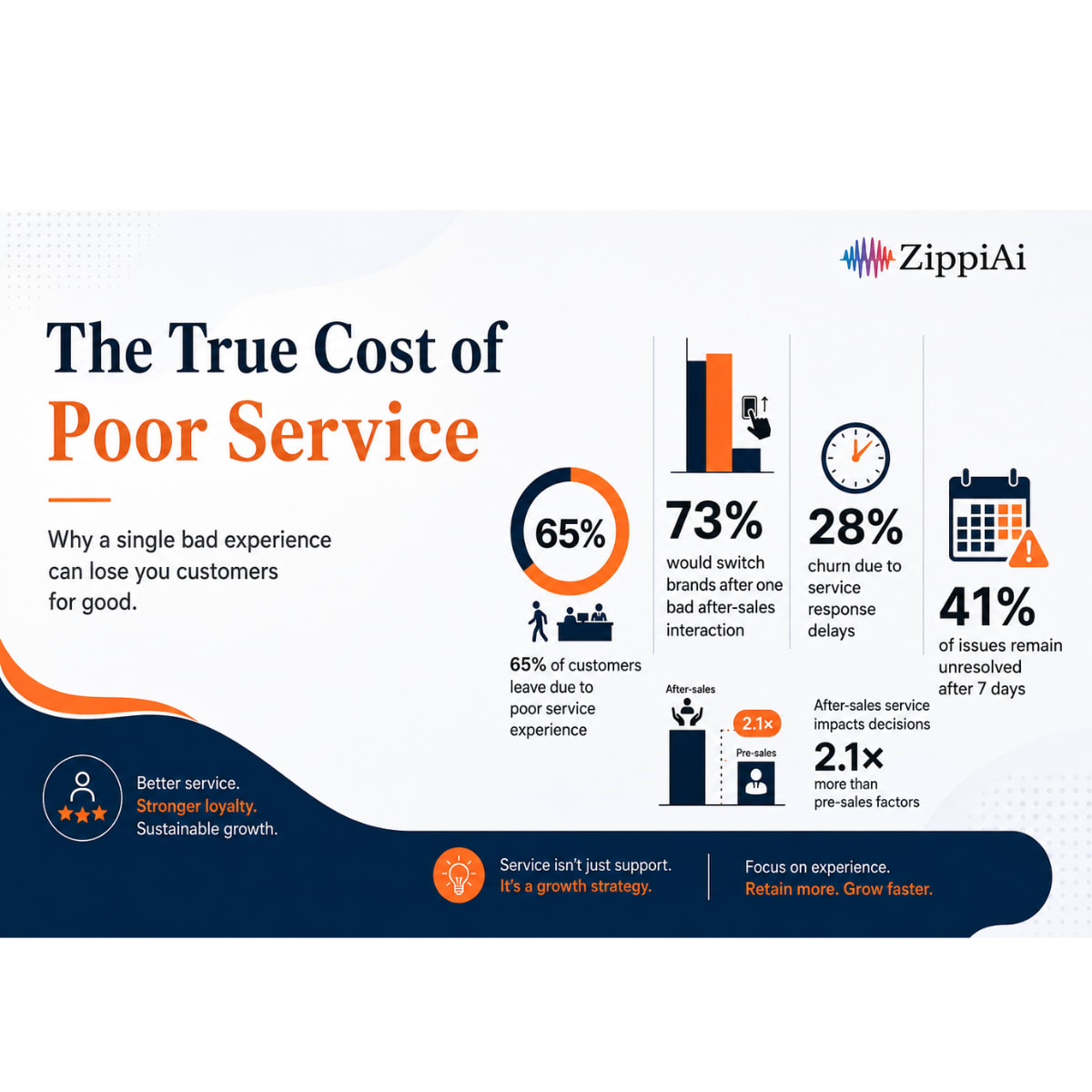
65% of customers who leave a brand cite poor service experience as the primary reason — not price, not competition.
73% of customers report they would switch brands after a single unsatisfactory after-sales interaction.
After-sales service influences purchase decisions at 2.1× the weight of pre-sales factors such as advertising, reviews, or in-store experience.
28% of churned customers cite avoidable delays in service response as the deciding factor.
41% of reported service issues remain unresolved within seven days of being logged.
Read these numbers together and a clear picture emerges. The majority of customers who leave are not leaving because a competitor offered them a better product or a lower price. They are leaving because the organisation failed them at the moment they needed it most. And that moment, almost always, comes after the sale.
The 2.1 times figure deserves particular attention. It suggests that the investment most manufacturers make in pre-sale activity — the marketing spend, the channel incentives, the product launches — is being partially undone by a post-sale experience that does not match the promise made at the front end. Customers are being acquired on one brand experience and retained (or lost) on an entirely different one.
A brand that wins the sale but loses the service moment has not built a customer. It has built a transaction.
The Root Cause Is Structural, Not Operational
It would be convenient to frame this as an execution problem — technicians who need better training, call centres that need more staff, spare parts inventory that needs better management. Those are real issues, but they are symptoms.
The root cause is a mindset that treats the customer relationship as complete once the product leaves the warehouse. This transactional view of the business is baked into how most manufacturing organisations are structured. Sales teams are measured on units moved. Service teams are measured on cost per call. No one is clearly accountable for the lifetime value of the customer.
This structural misalignment means that when a customer contacts the service organisation, they are not being handled by a function that understands its strategic importance. They are being handled by a cost centre trying to close tickets efficiently. The incentives are wrong, and the outcomes reflect that.
There is also a data problem. Most manufacturers have detailed visibility into production metrics, defect rates, and dealer sell-through. Very few have real-time visibility into how long a service request takes to resolve, how many require multiple visits, or which geographies are underperforming on response time. Decisions cannot be made on data that does not exist.
What Happens If This Does Not Change
The consequences of inaction are not speculative. They are already visible in the market dynamics of mature appliance categories.
First, commoditisation accelerates. When customers cannot differentiate brands on service quality — because most brands are equally poor — they default to price. Margin pressure follows. The brands that survive commoditisation are either the lowest-cost producers or the ones that have built genuine loyalty through experience. There is no middle ground that remains stable.
Second, the distribution of trust shifts. Word of mouth has always mattered in consumer durables, but at a time when a single service failure can generate hundreds of negative reviews visible to future buyers, the cost of a poor service experience extends far beyond the individual customer. One family's difficult summer with an unresponsive service team is a data point for thousands of others making a purchase decision.
Third, the window for differentiation is closing. Several brands — domestic and international — are beginning to treat after-sales as a competitive moat rather than a necessary cost. Once a competitor establishes a meaningful gap in service quality and communicates it effectively, it becomes very difficult to close. The brands that move first on this will have a structural advantage that is not easily replicated.
The Shift That Is Already Underway
The manufacturers who are navigating this well share a common characteristic: they have stopped treating service as a reactive function and started treating it as a retention function. The distinction matters more than it sounds.
A reactive service function measures itself on resolution speed and cost efficiency. A retention-oriented service function measures itself on customer outcomes — was the issue resolved to the customer's satisfaction, did the interaction rebuild trust, is this customer likely to return? These are different questions, and they produce different operational priorities.
This shift requires changes at multiple levels: how service organisations are structured and incentivised, how data is collected and used to anticipate failures before customers experience them, how technician networks are managed and empowered, and how leadership communicates the strategic importance of the post-sale relationship internally.
None of this is simple. But the organisations that have made this shift are seeing measurable differences in customer retention, in repeat purchase rates, and in the volume of referrals they receive. The economics are not difficult to model once you accept that the customer relationship has value beyond the initial sale.
In a market where products have become increasingly similar, the experience of being served is the last remaining differentiator that is genuinely hard to copy.
The Real Competitive Question
The consumer durables industry has always competed on engineering, on features, on price points, and on distribution reach. These remain important. But none of them, individually or together, are sufficient to retain a customer who has experienced poor service.
The manufacturers who will lead their categories over the next decade are not necessarily those with the most innovative products. They are the ones who understand that the customer's experience of the brand does not peak at the moment of purchase — it is defined by what happens when something goes wrong.
Every organisation in this industry already knows this, at some level. The harder question is whether the structures, the incentives, and the investment priorities actually reflect it.
That is the question worth asking in the next leadership meeting — not how many units were shipped, but how many customers were retained, and why.
Sources & References
- Focus Digital – Average Customer Retention Rate by Industry
- CustomerGauge – Customer Retention Benchmarks Report
- Exploding Topics – Customer Retention Statistics
- WorldMetrics – Customer Experience in Manufacturing Industry Statistics
- Zipdo – Customer Experience in Manufacturing Industry Report
- DemandSage – Customer Retention Statistics