Why Voice AI Companions Are Replacing IVRs in Consumer Electronics
How smart products outgrew dumb support systems — and what comes next
Smart TVs now adjust picture quality based on ambient light. Washing machines detect load imbalance mid-cycle and self-correct. Speakers learn the acoustics of a room and tune themselves accordingly. Robot vacuums map a home, remember furniture layouts, and decide their own cleaning routes. Consumer electronics has spent the last decade getting genuinely intelligent, not as a marketing claim, but as a measurable shift in how these products behave.
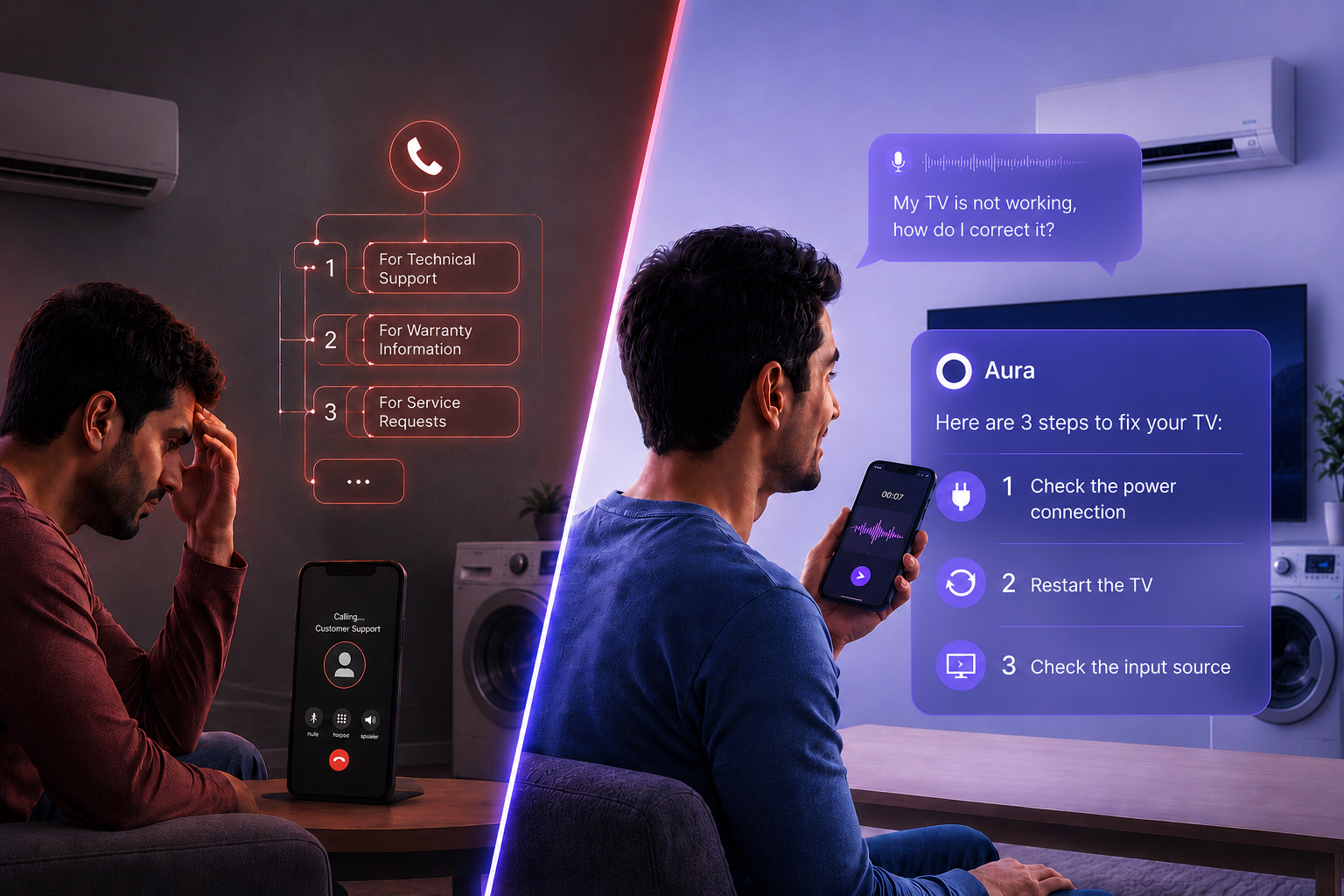
Call support for any of these products, though, and you’re transported back to 2004. “Press 1 for setup. Press 2 for billing. Press 3 for technical issues.” Guess wrong, and you’re rerouted, repeating your account number and your problem to someone new, who asks the same diagnostic questions the menu should have already covered.
The product learned. The support system didn’t.
That gap, between how intelligent the product is and how rigid the support experience remains, is exactly why IVRs are losing ground with CX leaders across the industry. It’s not a minor UX complaint anymore. It’s becoming a brand differentiator, and in some categories, a churn driver. As consumer electronics products get more capable and more software-dependent, the support experience around them is under more scrutiny than ever, and increasingly, it’s the thing customers remember most after the sale.
This isn’t a call for brands to rip out their entire support infrastructure overnight. It’s worth understanding precisely why the IVR model is breaking down, what’s replacing it, and why that replacement matters far beyond the contact center.
Why IVRs Are No Longer Enough
IVRs were never built to understand customers. They were built in an era of rotary-to-touchtone transition, designed to route calls efficiently, directing volume away from live agents and toward predefined categories. For simple, predictable issues, billing questions, order status, password resets, that worked fine. The logic was sound: most calls fall into a handful of buckets, so build a tree that sorts people into those buckets quickly.
Consumer electronics problems rarely fit that model anymore. A washing machine that “won’t start” could mean a power supply issue, a door latch sensor malfunction, an unbalanced load triggering a safety lock, or a firmware bug introduced in a recent update. A smart TV that “won’t connect” could be a router issue, an HDMI handshake failure, a DNS problem, or an app-specific bug that has nothing to do with the network at all. None of these fit neatly into a four-option menu.
A menu tree forces the customer to translate their real problem into the closest pre-written option, even when none of them match. This creates friction in several predictable, well-documented ways.
First, customers have to self-diagnose before they’ve even spoken to anyone. They’re asked to categorize a problem they don’t fully understand, using categories written by someone who has never seen their specific product behave this way. Second, they repeat information at every transfer because IVRs don’t retain context. Account number, model number, the issue itself, the troubleshooting steps already attempted, all of it gets re-explained from scratch the moment a call moves from menu to queue to agent. Third, multi-symptom problems simply don’t have a button for them. A smart speaker that disconnects only when a specific streaming app is open, or a TV that lags only during high-motion content, doesn’t map to any single menu category because it’s not a single, isolated issue. It’s an interaction effect, and IVRs have no mechanism for capturing that nuance.
There’s also a quieter cost that doesn’t show up in average handle time metrics: abandonment. A customer who gives up after the third wrong menu doesn’t always call back. They post a one-star review, return the product, or simply stop engaging with the brand. None of that shows up as a “resolved” or “escalated” ticket, but it shows up in churn and in product reviews that future buyers read before they purchase.
The result is a system optimized for call volume, not customer understanding. Customers adapt to the system instead of the system adapting to them. In a market where the product itself is intelligent, where the washing machine can detect its own imbalance but the support line can’t understand a sentence, that mismatch stands out more than ever, and customers notice it.
The Voice AI Companion Difference
Voice AI Companions flip the model entirely. Instead of asking customers to navigate menus, they interpret what’s actually being said, in the customer’s own words, with all the imprecision and context that comes with natural speech.
A customer can say, “My TV connects to Wi-Fi but the streaming apps keep buffering, it started a couple of days ago,” and the system understands intent immediately. No menu translation required, no guessing which category fits best. It can ask clarifying questions like a knowledgeable technician would: “Is this happening on all apps or just one? Has anything changed recently, like a router update or a new device on the network?” These aren’t scripted branches; they’re dynamically generated based on what the customer has already said, which means the conversation narrows toward a resolution instead of widening into more confusion.
Critically, it retains context throughout the conversation. If the issue escalates to a human agent, or if the customer calls back the next day because the fix didn’t fully work, nothing needs to be repeated. The system already knows the model number, the troubleshooting steps attempted, and the specific symptoms described.
Consider the before-and-after, drawn from a fairly typical consumer electronics support scenario:
Before (IVR): Customer presses through four menus, unsure which one fits “buffering issue.” Repeats their account number twice, once to the IVR, once to the agent. Waits on hold for several minutes. Finally explains the buffering problem to an agent who asks the same diagnostic questions the IVR already should have asked: model number, when it started, which apps are affected. Total time to resolution: 18 to 25 minutes, often across more than one call.
After (Voice AI Companion): Customer describes the issue naturally, in one sentence, the way they’d describe it to a friend. The system asks two targeted follow-up questions, cross-references the symptom pattern against known issues for that TV model, identifies it as a bandwidth allocation issue common to that firmware version, and walks the customer through a fix in real time. No transfer, no repetition, no hold music. Total time to resolution: under five minutes.
The difference isn’t just speed, though speed matters. It’s that the interaction feels like troubleshooting with someone who already understands the product, rather than someone reading from a script they didn’t write and can’t deviate from. That distinction is what customers actually remember and talk about.
Beyond Support: The Product Intelligence Advantage
This is where Voice AI Companions create value that IVRs structurally cannot, and it’s arguably the more important shift for product and CX leaders to understand, even more than the resolution-time improvements.
Every IVR interaction is a dead end, informationally speaking. A customer presses a button, gets routed, and whatever nuance existed in their original problem disappears into a category label and, eventually, a call log nobody reviews at scale. A “technical issue” ticket tells you almost nothing about what’s actually going wrong with the product. A Voice AI Companion, by contrast, captures the actual language customers use to describe problems, which is a fundamentally richer and more analyzable data set.
Patterns emerge that wouldn’t surface otherwise, and they emerge faster than they would through traditional channels like surveys or warranty claims. If hundreds of customers describe the same washing machine model as “not starting” within the first week of ownership, that’s not a support ticket, that’s an installation friction signal pointing to a setup instruction that’s unclear or a part that’s commonly mis-installed. If a recurring phrase, like a specific error tone or a particular app freezing, points to a specific smart-speaker firmware version, that’s an early defect signal that can reach engineering before it becomes a recall or a wave of negative reviews. If customers consistently struggle to find a feature during setup conversations, asking the same “how do I turn on…” question across thousands of calls, that’s an adoption gap product teams can act on immediately, whether through UI changes, onboarding flow adjustments, or clearer documentation.
This is the shift ZippiAI’s Aura is built around: support conversations aren’t just resolved, they’re structured into intelligence that product, engineering, and CX teams can actually use without manually combing through call transcripts. Instead of support data sitting in a ticketing system that nobody outside the support org opens, it becomes a continuous feedback loop back into product development, surfacing the kind of granular, real-world usage friction that’s nearly impossible to capture through NPS surveys or post-purchase questionnaires.
The conversation that solves one customer’s problem can also flag the issue affecting the next thousand customers who haven’t called yet, but will, unless something changes upstream.
Conclusion
The shift underway isn’t cosmetic, and it isn’t just about faster call resolution, though that’s a welcome side effect. It’s a move from call routing to issue resolution, from automation built for efficiency’s sake to automation that understands context and nuance, and from support centers treated purely as cost centers to support functions that double as customer insight engines feeding directly into product strategy.
Consumer electronics brands investing in this shift aren’t just reducing handle times and improving CSAT scores, though those metrics matter and tend to move quickly. They’re building a direct, real-time line into how customers actually use their products, where they get stuck, what confuses them, and what breaks down after the box is opened. That’s information no survey or NPS score captures as precisely, because it’s gathered at the exact moment a customer is experiencing friction, in their own words, without the filtering and forgetting that happens when feedback is collected days or weeks later.
The future isn’t about improving IVRs. It’s about building systems that understand customers.
Key Takeaways
- IVRs are structurally limited for modern consumer electronics support. They were designed for call routing in a simpler product era, not for understanding multi-symptom, unpredictable issues that today’s smart products generate.
- Voice AI Companions reduce customer effort, not just call time. Natural language understanding and context retention eliminate the need for customers to repeat themselves, self-diagnose, or re-explain their issue at every transfer.
- Support conversations are an underused product intelligence source. Patterns in how customers describe problems can surface installation friction, adoption gaps, and emerging defects long before they show up in returns, reviews, or warranty data.
- Where is your support stack right now: still routing calls, or already learning from them? Curious how other CX and product leaders are approaching this shift, drop your experience in the comments.