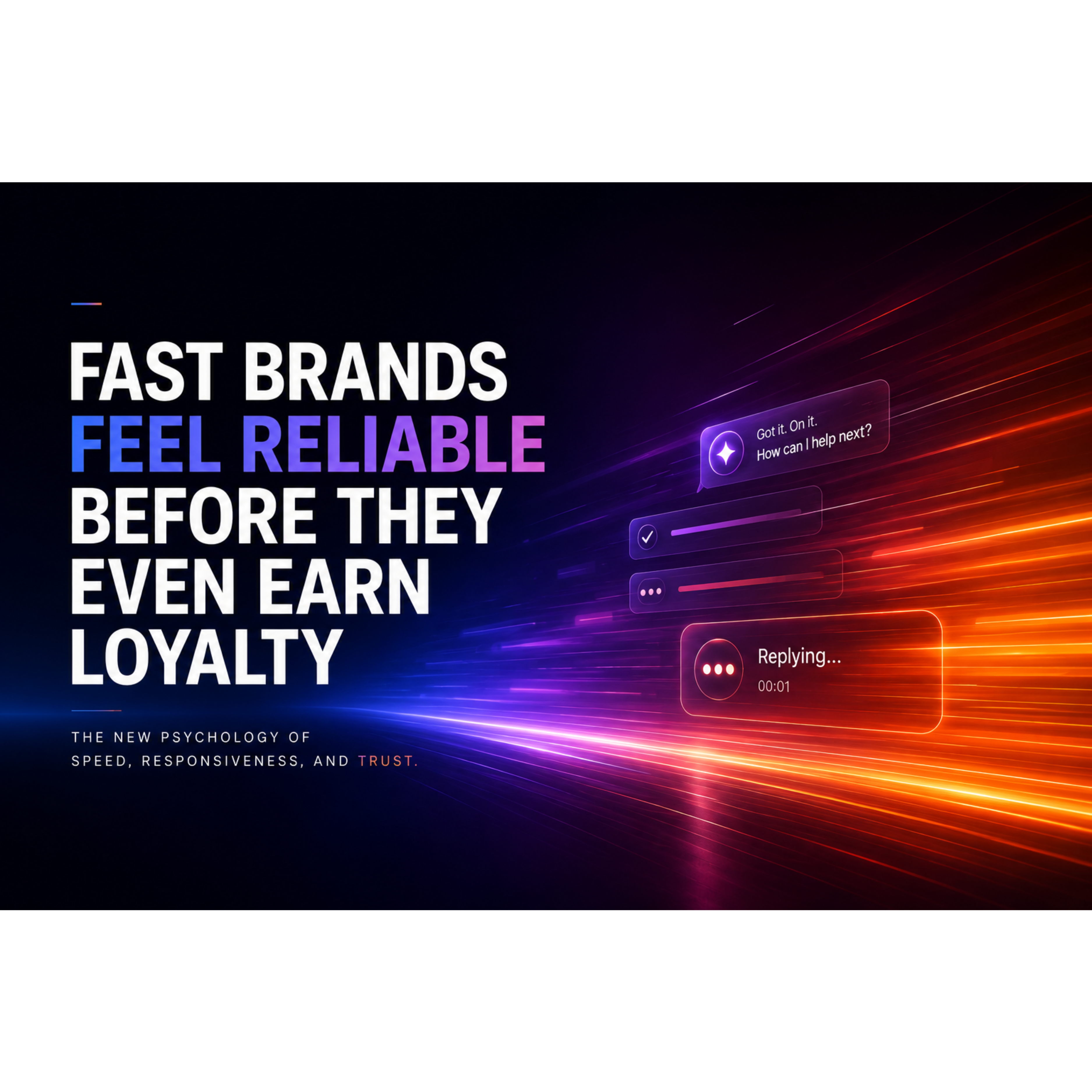
Why Customers Trust Fast Brands More Than Big Brands
The old rules of trust are being rewritten — and most companies haven't noticed yet.
For decades, the formula was simple: get big, get trusted. Build a recognizable logo. Run enough ads. Survive long enough. Trust would follow.
That formula is dead.
Today's customer doesn't care how old your company is. They don't care about your legacy, your awards, or the size of your headquarters. They care about one thing: how fast you show up when they need you.
Speed has become the new credibility.
The Expectation Shift Nobody Talks About Honestly
Something fundamentally changed when smartphones became the primary interface between brands and customers. It wasn't just that people could shop from their couch. It was that they could now compare, complain, cancel, and praise — all within seconds.
The reference point for "acceptable response time" stopped being other businesses. It became WhatsApp. It became Instagram DMs. It became the instant confirmation screen after tapping "Order."
When a customer messages your brand and hears nothing for six hours, they're not comparing you to your competitor. They're comparing you to the last time they texted a friend and got a reply in 90 seconds.
You're losing that comparison every single time.
The digital-native consumer has been quietly recalibrating what trust means. It's no longer about heritage. It's about presence. And presence, in 2025, is measured in minutes — not days.
Speed Is a Psychological Signal, Not Just a Metric
Here's the counterintuitive truth most business leaders miss: customers don't want fast responses because they're impatient. They want fast responses because speed communicates something deeper.
Speed says: you matter to us right now.
When a brand responds quickly, the brain doesn't just process information — it processes status. It registers that the company sees you, prioritizes you, and has its act together. Slowness, by contrast, triggers quiet doubt. Are they overwhelmed? Understaffed? Do they even care?
This is behavioral psychology operating silently beneath every customer interaction.
Research in decision-making consistently shows that people use responsiveness as a proxy for reliability. If you can't answer a pre-sale question quickly, why would a customer trust you to resolve a post-sale problem? The logic is ruthless, but it's real.
The fast brand doesn't just feel more helpful. It feels more trustworthy. More competent. More worth the money.
What Silence Actually Costs You
Companies obsess over churn metrics. NPS scores. CSAT surveys. But almost none of them track the damage done by delayed communication — and that damage is significant.
A customer who submits a support ticket and hears nothing for 12 hours has already begun mentally rehearsing their negative review. They've probably vented to someone. They may have screenshotted the silence and posted it. And when the reply finally arrives — even a good one — it lands on already-damaged ground.
The reply doesn't reset the experience. It inherits it.
This is what makes slow communication so dangerous: the harm is invisible in real time. No immediate cancellation. No immediate complaint. Just a quiet erosion of confidence that shows up three months later as churn you can't explain.
Silence is never neutral. It's always a message. And the message is: we weren't ready for you.
Why Smaller Brands Are Winning the Trust Game
If you've watched a scrappy 30-person startup eat into market share that a 3,000-person enterprise should own, you've seen this dynamic play out firsthand.
The startup responds to a demo request in 11 minutes. The enterprise sends an automated acknowledgment and books a discovery call for next Thursday.
By Thursday, the customer has already signed with the startup.
This isn't about resources. The enterprise has more resources. It's about architecture — specifically, the organizational and technical architecture of responsiveness.
Large companies often have more process than agility. More approvals than answers. More departments than decisions. They've optimized for scale, not speed. And in an era where speed is the differentiator, that's a structural liability.
The fast brand doesn't win because it's better. It wins because it was there — present, coherent, and ready — at the exact moment the customer needed it.
In modern commerce, showing up fast is a form of quality.
The Brands Getting This Right
Look at how Intercom-powered SaaS startups handle inbound leads. A prospect fills out a form at 11 PM. Within 90 seconds, they get a personalized message — not a generic autoresponder, but a contextual reply that references what they asked, what their company does, and what the next step looks like.
That's not magic. That's infrastructure.
E-commerce brands using AI-powered support are resolving 70–80% of customer queries before a human ever touches them — with response times under two minutes. The customer doesn't know or care whether it's AI or human. They know the problem got solved while they were still at their laptop, and that's the experience they'll talk about.
Contrast that with a well-known legacy retailer whose support queue stretches 48 hours. The brand is trusted in theory — decades of goodwill, massive ad spend, household recognition. But in the moment of friction, that trust evaporates. Because trust isn't a bank account you can draw from indefinitely. It's a live signal, regenerated every time you interact.
AI Is the Infrastructure, Not the Gimmick
Let's address the technology piece directly, because it's often either overhyped or dismissed.
AI-powered communication tools are not a customer service trend. They're becoming the baseline infrastructure for competitive responsiveness — the same way cloud hosting became table stakes for any serious digital business in the 2010s.
The brands that are pulling ahead aren't using AI to cut costs (though it does that too). They're using it to compress the gap between customer need and brand response. They're using it to be present at 2 AM when a customer in a different timezone has an urgent question. They're using it to handle volume spikes without degrading experience quality.
This matters most at the edges of the customer journey — the moments of peak anxiety, peak excitement, or peak frustration. Those moments don't wait for business hours. And they don't wait for the support team to finish their current queue.
The fastest brands aren't bigger. They're better wired.
An AI that delivers a relevant, warm, useful response in 60 seconds doesn't replace human connection — it makes human connection possible at scale, by handling everything that doesn't require it.
The Emotional Architecture of a Fast Response
Strip away all the business logic, and here's what a fast brand actually delivers on an emotional level: certainty.
Modern customers are navigating enormous decision fatigue. They're evaluating products, comparing prices, reading reviews, second-guessing choices. In this state, uncertainty is psychologically exhausting.
A fast response cuts through that fog.
When you reply quickly, you're not just answering a question. You're giving the customer permission to stop searching. You're signaling: this is a safe place to land. We're stable. We're here. You can trust this.
That's not a soft benefit. That's conversion. That's retention. That's the difference between a customer who buys and one who abandons and goes back to Google.
And on the flip side — when a response takes too long, the customer fills the silence with their own narrative. Usually, that narrative is unkind. Anxiety expands to fill the available space. Doubt becomes the default.
Fast communication is, at its core, an act of reassurance. And reassurance is one of the most underrated drivers of purchase behavior.
What This Means for Sales, Support, and Retention
Sales: The fastest responder wins the deal more often than the best responder. Speed signals hunger and competence simultaneously. A salesperson who follows up within five minutes of a form submission converts at dramatically higher rates than one who waits until morning.
Support: Every support interaction is either a retention moment or a churn moment. Speed determines which one it becomes. A problem resolved in two minutes reinforces loyalty. The same problem resolved in two days teaches the customer that switching is worth the effort.
Retention: The brands customers stay with aren't always the ones with the best product. They're the ones where the experience of needing help was never a bad experience. Responsiveness is what makes a brand feel safe to depend on over time.
The through-line is simple: customers don't separate the product from the experience of being a customer. To them, it's one thing. And responsiveness is a massive part of what makes that thing feel good or feel broken.
The Future Belongs to the Responsive
Here's where this is all heading: trust, as a competitive asset, is being decoupled from size and longevity and re-coupled to something more dynamic.
The brand that earns trust in the next decade will be the one that consistently shows up — accurately, helpfully, and fast — across every touchpoint, at any hour, in any channel. Not the one with the biggest billboard. Not the one with the longest history.
This is a reordering of the entire hierarchy of brand value. And it's happening faster than most organizations are prepared to acknowledge.
The good news: responsiveness is buildable. It's an architectural choice, not a personality trait. The right processes, the right tools, and the right cultural commitment can turn a slow brand into a fast one — and a fast brand into a trusted one.
The companies that understand this earliest will have a compounding advantage that's hard to reverse. Because once customers experience what genuine responsiveness feels like, going back to slow becomes genuinely difficult to accept.
The question isn't whether your brand is big enough to be trusted. The question is whether you're fast enough to earn it.
The clock is already running.
If this resonated, share it with someone building a brand, leading a team, or thinking hard about customer experience. The conversation matters.