The Sale Is Not the Win. The Post-Purchase Experience Is Where You’re Losing Customers
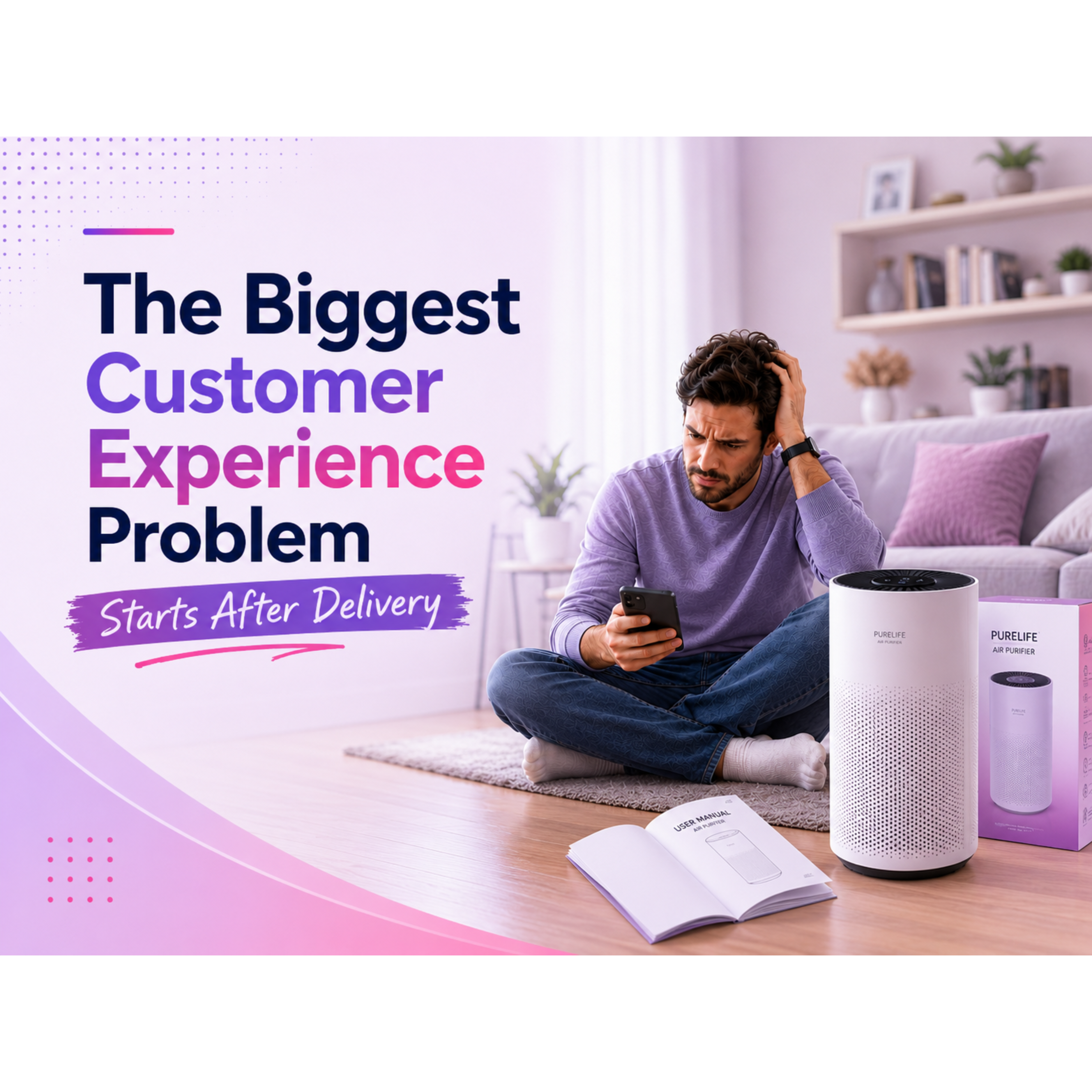
A family buys a new air purifier. Top-rated. Well-reviewed. They unbox it on a Saturday afternoon, plug it in, and stare at the control panel. There are four buttons, two indicator lights, and a faint beep that means something. By Sunday evening, they’ve called customer support twice. By the following weekend, the purifier is running on the lowest fan speed — where it will stay, indefinitely — because nobody figured out the auto mode.
The product didn’t fail. The experience did.
This is the story playing out in millions of homes, every day, across every category in consumer electronics — TVs, routers, water purifiers, smart appliances, air conditioners. Brands spend enormous energy getting customers to the point of purchase. Then they essentially let go of their hand and walk away.
The result is a quiet crisis that doesn’t show up on launch dashboards, but absolutely shows up on support queues, return rates, and churn numbers.
The Gap Nobody Talks About
The consumer electronics industry has become exceptionally good at two things: making technically impressive products and marketing them brilliantly. Go-to-market strategies are elaborate and well-funded. Launch campaigns are cinematic. In-store experiences are carefully designed.
Then the product goes home.
And between “the customer received the box” and “the customer is happily using the product,” there is a gap so wide you could lose entire customer relationships in it — and brands routinely do.
Think about what actually happens in the first 72 hours of ownership. A customer unboxes a smart router. They go through a setup process that assumes a certain level of technical comfort. They see terms like “2.4GHz band” and “QoS settings” and quietly panic. They get the internet working — barely — and never touch the app again. The parental controls, the guest network, the bandwidth prioritization they paid a premium for? Untouched. Forever.
This isn’t a product problem. This is an ownership experience problem.
The purchase journey ends at checkout. The customer journey is just beginning. And most brands have very little infrastructure, strategy, or even awareness for what happens next.
Most Support Tickets Aren’t Product Failures
Here’s a number that should make every product leader uncomfortable: a significant portion of support calls and service requests in consumer electronics are not caused by defective products.
They are caused by confused customers.
A customer calls because their smart TV “keeps disconnecting from Wi-Fi.” The technician walks through a checklist, discovers the TV is on a 5GHz network with weak signal, switches it to 2.4GHz, and the problem disappears in four minutes. No hardware failure. No software bug. Just a setup configuration the customer didn’t know existed.
A customer raises a complaint that their water purifier’s filter indicator light is blinking red. They’re convinced the machine is broken. The service team explains, patiently, that it simply means the filter needs replacement — a routine maintenance event clearly explained in chapter four of the manual nobody read.
These are called “false failures” in the industry — and they are expensive in every direction. They cost brands in service dispatch costs, call center minutes, and technician visits. They cost customers in frustration, time, and eroded trust. And they quietly chip away at brand perception, because the customer doesn’t remember that the product worked fine. They remember that they had a problem.
The root cause is almost never the product. It’s the absence of proactive, contextual guidance at the moment the customer actually needed it.
The Manual Is Dead. It Just Doesn’t Know It Yet.
Let’s be honest about something: nobody reads the manual.
This isn’t laziness. It’s human behavior. Modern consumers are accustomed to products that are intuitive — or at least guided. They expect the experience to teach them, not a 64-page booklet translated from three languages that assumes they have a background in electrical engineering.
The manual was designed for a different era of product and a different type of user. Today’s consumer electronics are dramatically more capable and dramatically more complex than their predecessors. The idea that a static document can adequately guide someone through a modern smart appliance ecosystem is optimistic at best.
What users actually need is contextual help — guidance that appears when and where they need it, in plain language, relevant to what they’re trying to do right now. Not chapter seven. Now.
Some brands have started building this into apps and digital touchpoints, but it remains the exception rather than the rule. Most post-purchase communication is still reactive: wait for the customer to be frustrated, then respond. The entire model needs to flip. Proactive, intelligent onboarding — not a PDF attached to an order confirmation email — is what the moment demands.
Customers Are Using Maybe 30% of What They Paid For
Here’s what makes the ownership gap not just a support problem, but a business strategy problem.
Your customers are using a fraction of what they bought.
The premium air purifier has a sleep mode, a child-lock feature, an air quality index display, a scheduling function, and integration with a smart home ecosystem. Customers are using: on/off and fan speed. That’s it.
The flagship smart TV supports Dolby Atmos, has a built-in ambient mode that turns the screen into art when idle, offers a gaming mode with reduced input lag, and can serve as a hub for home automation. Most customers use it to watch Netflix on “Standard” picture mode because they never ran the picture calibration setup.
This is the feature adoption gap. And it has profound consequences.
When customers don’t use the full product, they don’t feel the full value. When they don’t feel the full value, they don’t become loyal customers — they become price-sensitive switchers. They look at the next purchase cycle and think, “I paid a lot for that last one and honestly it wasn’t that different from a cheaper brand.” They weren’t wrong that it wasn’t different — they just never discovered why it was.
Feature adoption isn’t a nice-to-have. It’s the engine of perceived value, loyalty, and word-of-mouth. A customer who discovers and uses the sleep scheduling feature on their air purifier is a fundamentally different customer — more satisfied, more likely to repurchase from the same brand, more likely to recommend it.
The ownership experience is the delivery mechanism for the value that the product team spent years building.
Support Is a Revenue Channel. Start Treating It Like One.
The traditional framing of customer support is cost containment. How do we reduce ticket volume? How do we cut average handle time? How do we deflect calls to self-service?
These are valid operational questions. But they start from the wrong premise.
Support interactions are the most direct, high-intent conversations a brand has with its customers at scale. A customer who calls because they can’t figure out how to set up a second user profile on their water purifier is a customer who is engaged, who is using the product, and who wants to get more value from it. That is not a cost to minimize. That is a relationship to deepen.
A skilled support interaction — one that resolves the issue, discovers what the customer is actually trying to achieve, and then proactively introduces them to two more features they didn’t know existed — is worth more than almost any marketing touchpoint.
Done well, support becomes the place where a single-product buyer becomes a multi-product household. Where a first-generation customer becomes a brand loyalist who upgrades within the same ecosystem. Where a confused user becomes an advocate.
Brands that rethink support as a retention and upsell function — not just a cost center — will have a structural advantage in customer lifetime value. The conversation infrastructure is already there. What’s missing is the strategy and the training to use it.
The Data Sitting Unread in Your Post-Purchase Interactions
Every support call, every app session, every feature inquiry, every return request is a data point. Aggregated, these data points tell you things that no focus group or survey ever will.
They tell you which features are universally confusing. Which setup steps cause the most drop-off. Which use cases customers actually care about versus the ones product teams assumed they would care about. Which pain points consistently appear in month three of ownership — predictably, preventably — and what they actually signal about the product or the onboarding design.
Most brands are not reading this data systematically. It exists — in support logs, in app behavior analytics, in service dispatch records — but it rarely makes its way back to product teams in a structured way. It almost never influences the next product generation or the next marketing campaign.
This is an untapped goldmine.
A brand that builds a feedback loop between post-purchase experience data and product strategy is a brand that continuously improves not just its products but its customers’ ability to benefit from those products. It can prioritize the next firmware update based on real confusion patterns rather than internal assumptions. It can redesign the onboarding flow based on where users actually drop off. It can brief the marketing team on which features are resonating post-purchase — so the next campaign leads with those features, not the ones that look impressive in a spec sheet.
Post-purchase data is arguably more valuable than pre-purchase research. It reflects real behavior, not stated preferences. It’s honest in a way that surveys never quite are.
The Future Is Ownership Experience, Not Just Support
The consumer electronics brands that will win the next decade are not necessarily the ones with the most advanced products — though that matters. They’re the ones that design the full arc of ownership, not just the product itself.
What does this look like in practice?
It looks like intelligent onboarding that meets users where they are — whether they’re tech-savvy early adopters or first-time smart appliance buyers. It looks like proactive check-ins at key moments: day three, week two, month one — moments when confusion typically peaks or feature discovery typically drops off. It looks like support interactions designed to add value, not just resolve tickets. It looks like product teams that treat post-purchase data as seriously as they treat pre-launch market research.
The category is moving this direction whether brands lead it or follow it. Customers have been trained by software companies — by apps and platforms that onboard them carefully, guide them continuously, and improve based on how they actually behave — to expect the same from physical products.
The air purifier doesn’t get to say it’s “just hardware.” Not anymore.
The brands that close the ownership gap will find something interesting on the other side of it: customers who feel genuinely taken care of. Who use more of what they paid for. Who call support less, repurchase more, and recommend without being asked.
The sale was never the finish line. It was the starting gun.
If you’re leading a product, CX, or brand team in consumer electronics and this resonates — the question worth asking isn’t “do we have a post-purchase problem?” Almost certainly, you do. The question is: where exactly does the ownership experience break down for your customer, and what would it take to fix it?
That’s where the next competitive advantage lives.