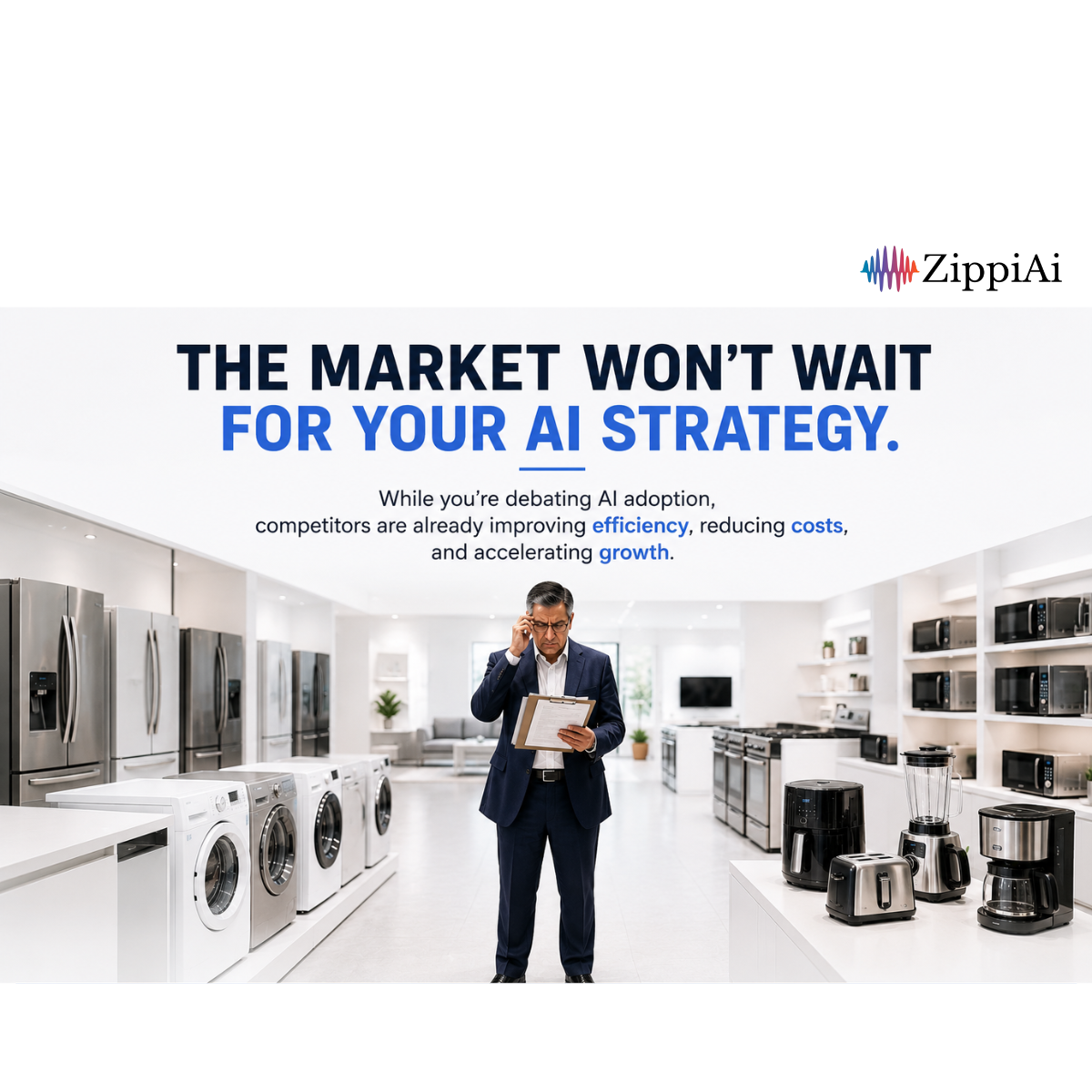
The Market Won't Wait for Your AI Strategy
Walk into any well-run electronics and home appliances showroom today and you'll see the usual scene. Refrigerators lined up in gleaming rows. Washing machines stacked side by side. Smart TVs flickering with demo reels. Customers moving slowly through the aisles, comparing features, asking questions.
Everything looks normal. Business as usual.
But look closer — at the decisions being made in the back office — and a very different picture emerges.
Rajan had run his family's appliances retail chain for eleven years. Three stores. A loyal customer base built over decades. He was good at this. He knew his suppliers, his margins, his peak seasons. When AI started becoming a topic at industry conferences around two years ago, he listened politely, nodded along, and filed it away under "things to revisit when things settle down."
Things never settled down. They never do.
Meanwhile, a competitor forty kilometers away — a chain half the size of Rajan's — was quietly doing something different. They had begun using AI tools to forecast which models would sell in which neighborhoods before the season hit. Their inventory sat lean and right. Their salespeople walked into every conversation already knowing which three models a customer was likely to prefer, based on browsing behavior and purchase history. Their support team had automated 60% of routine queries, freeing humans for the conversations that actually required judgment.
Rajan was still holding his weekly Tuesday meetings. Still reviewing last month's reports. Still discussing whether AI was worth the investment.
The cost of waiting is invisible until it becomes irreversible.
The Illusion of Safety
There is a particular kind of organizational comfort that comes from stability. When the business is running — when orders are coming in, when staff are showing up, when systems are humming along — it is very hard to feel urgency about change.
Most businesses that fall behind don't fall behind because they were careless. They fall behind because they were careful. They waited for more evidence. They ran more pilots. They formed more committees. They asked the right questions at the wrong pace.
The decision to wait feels safe because it is invisible. If you adopt a new system and it fails, the failure is visible. If you don't adopt it and your competitor quietly pulls ahead — month by month, percentage point by percentage point — that loss doesn't have a timestamp. It doesn't show up in a single quarterly report. It accumulates in the background, like interest on a debt you didn't know you were running.
Organizational psychologists call this status quo bias — the human tendency to prefer the current state of affairs even when changing it would produce better outcomes. In business, this bias gets amplified by hierarchy. Every layer of approval is another opportunity to delay. Every request for more data is another quarter lost.
Waiting for certainty in a fast-moving market is itself a decision — and rarely the right one.
History Has Seen This Before
The pattern is not new. It just keeps wearing different costumes.
Kodak engineers invented the digital camera in 1975. The company shelved it for fear of cannibalizing their film business. They weren't blind to the technology — they built it. But they couldn't bring themselves to act on what they saw. By the time the digital wave became undeniable, Kodak was already underwater.
Blockbuster had the chance to buy Netflix for fifty million dollars in 2000. They declined. Not because they lacked resources. Not because they were incompetent. But because their current model still seemed to be working. Why disrupt something that isn't broken? Ten years later, it was broken beyond repair.
Nokia dominated mobile phones. Borders ran great bookstores. Blackberry had enterprise email locked up. These weren't failures of intelligence. They were failures of urgency — of underestimating how fast the ground was shifting beneath them.
In each case, the disruption didn't happen overnight. The signals were there, months and years in advance. But acting on early signals requires accepting short-term discomfort in exchange for long-term survival. Most organizations find that trade very hard to make.
Market leaders rarely lose because they lack resources. They lose because they react too late.
Why AI Is Different This Time
Every generation of business leaders has to decide which new technology actually matters and which is just noise. That judgment is legitimate and important. Not every trend deserves to be chased.
But AI isn't a trend. It is quietly becoming the infrastructure of modern business — the way electricity became infrastructure a century ago. You don't ask whether to use electricity. You ask how.
The shift is already happening in practical, unglamorous, deeply useful ways.
In inventory management, AI systems analyze thousands of variables — seasonal patterns, regional preferences, economic signals, even weather forecasts — to predict what needs to be stocked, where, and when. The result isn't just efficiency. It's the difference between having the right air conditioner in the right store on the hottest week of the year and watching customers walk out the door.
In demand forecasting, businesses that previously relied on last year's numbers to plan this year's orders are now running models that update in real time. The precision gap between AI-assisted forecasting and traditional methods is widening every quarter.
In customer support, AI handles the high-volume, repetitive queries — warranty questions, delivery timelines, product comparisons — with speed and consistency no human team can match at scale. This doesn't replace the support team. It focuses them on the interactions that require empathy, judgment, and relationship.
In sales, AI surfaces insights that a salesperson simply doesn't have time to generate manually: which customer is most likely to upgrade, which product combination drives highest satisfaction, which follow-up timing has the best conversion rate. It turns average salespeople into informed ones.
In personalization, the customer who walks in having already interacted with a smart website or chatbot arrives better informed, more confident in their choice, and more likely to buy. The friction drops. The experience improves.
None of these applications require a PhD in machine learning. They require a business leader willing to engage seriously with tools that are already available, already proven, and already being used by competitors.
AI isn't making businesses smarter. It's making smart businesses faster — and the gap is growing.
The Hidden Cost of Waiting
Here is what the delay actually costs, in terms that don't show up in any single budget line.
Every month a competitor uses AI to optimize their inventory, they're reducing waste and improving cash flow. Every month you're not doing it, you're carrying stock that shouldn't be there and missing stock that should.
Every month a competitor's customer service runs faster and more accurately, they're building the trust that brings customers back. Customer experience compounds. So does customer attrition.
Every month their sales team operates with better intelligence, they're closing deals more efficiently. Every month yours doesn't, the gap in productivity quietly grows.
The cumulative effect is significant. A competitor who adopted AI tools eighteen months ago hasn't just gotten eighteen months of efficiency gains. They've gotten eighteen months of learning — of refining models, correcting errors, building institutional knowledge around how to use these tools well. That knowledge gap is much harder to close than a technology gap.
You can buy the same software tomorrow. You cannot buy the eighteen months of experience your competitor has already accumulated.
Technology gaps close quickly. Experience gaps don't.
This Is Not About Replacing People
One of the most persistent and damaging myths about AI adoption is that it's a trade: technology in, people out. This is not how it works in practice, and it's not how successful businesses are using it.
The businesses getting the most value from AI are using it to augment their people — to give their teams better information, faster answers, and more time for the work that actually requires a human.
A salesperson supported by AI-generated customer insights doesn't become redundant. They become remarkably more effective. They walk into a conversation prepared in a way their counterpart at a non-AI competitor simply isn't.
A warehouse manager using AI-assisted inventory planning doesn't lose their job. They gain the ability to spend less time on spreadsheets and more time on the supplier relationships and operational decisions that actually require their experience and judgment.
The organizations that struggle with AI adoption are often the ones that frame it as a replacement rather than an amplification. That framing creates resistance, fear, and friction. The organizations that frame it as a capability upgrade — this makes your team better at what they already do — tend to move faster and get better results.
The goal isn't to replace human judgment. It's to make human judgment faster and better-informed.
The Divide That's Coming
For most of the last two decades, the competitive divide in retail and distribution was between large and small. Big companies had buying power, marketing budgets, distribution networks. Small ones had agility and local knowledge.
AI is reshaping that divide in a fundamental way.
A small appliances retailer using AI tools effectively can now forecast demand with an accuracy that rivals much larger competitors. They can personalize customer interactions at scale. They can operate with inventory precision that larger, slower organizations struggle to match. The technology levels the playing field — but only for those who use it.
The emerging divide isn't large versus small. It's AI-enabled versus AI-absent. And the gap between those two categories is getting wider every quarter.
This isn't a prediction about five years from now. It's a description of what's already happening. The businesses on the right side of this divide are pulling ahead. The ones on the wrong side are, in many cases, not yet aware that they're falling behind.
The future will not divide winners from losers by size. It will divide them by adaptability.
The Market Won't Wait
AI is not a future consideration. It is a present competitive reality.
The businesses winning in electronics retail, home appliances, and consumer distribution today are not winning because they made a single brilliant decision. They're winning because they started building AI-enabled capabilities earlier, learned from them faster, and compounded those advantages over time.
The window for a slow, careful, we'll-get-to-it-eventually approach has already closed for many categories. In others, it is closing now.
This doesn't mean rushing blindly into expensive, unproven technology. It means engaging seriously — finding the use cases that map directly to your business challenges, running focused experiments, and building the organizational muscle to learn quickly.
Platforms like ZippiAI are being built specifically to help businesses in retail and distribution start that journey without requiring a full-scale technology transformation. The point isn't the tool. The point is the mindset: that AI adoption is no longer an innovation initiative. It is a business necessity.
Rajan eventually started. It took him longer than it should have, and the catch-up has been harder than the head start would have been. But the more instructive story isn't how he recovered.
It's how far ahead his competitor was by the time he began.
The market is not waiting for your AI strategy. It is being shaped by the people who already have one.