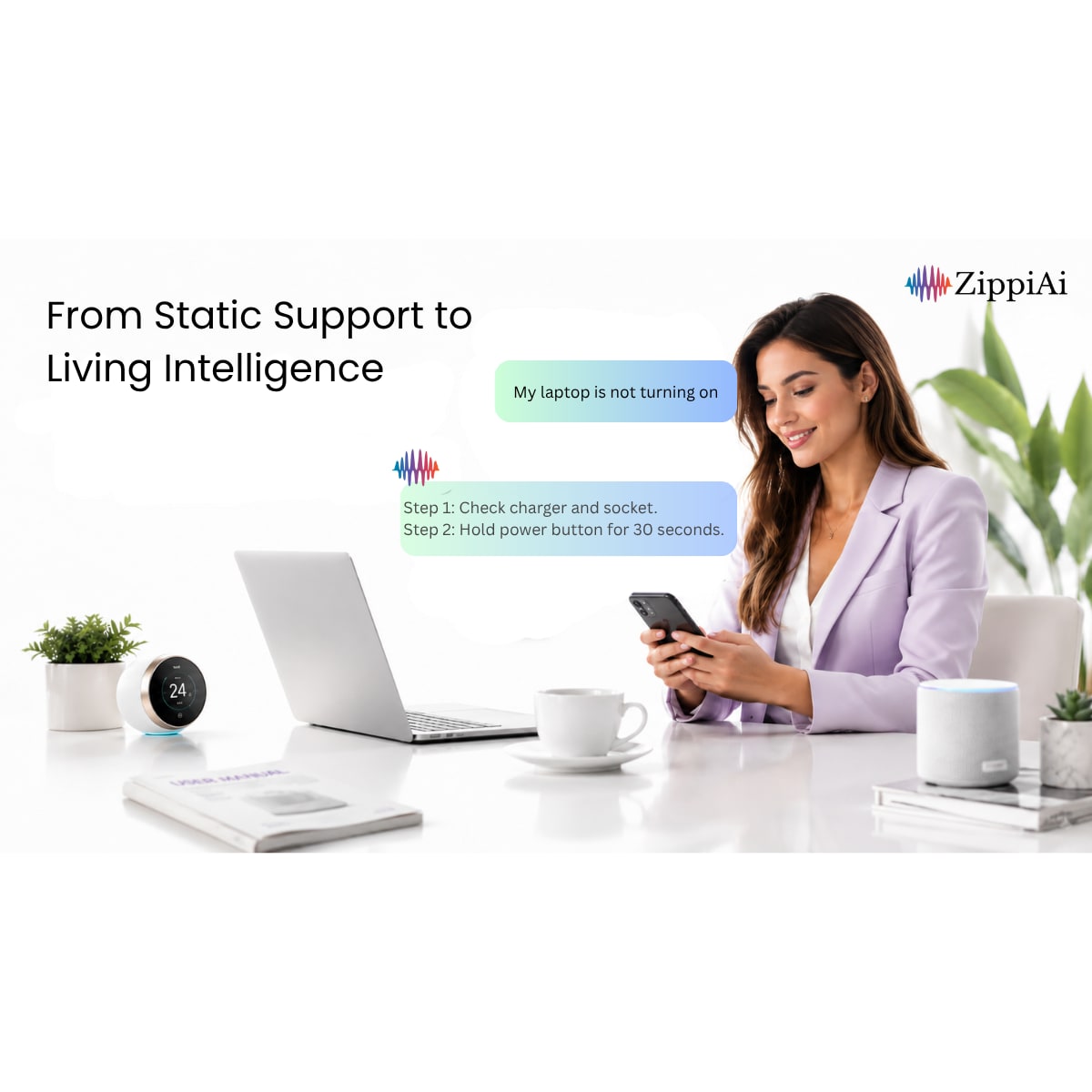
From Manuals to AI Companions: How AI Is Redefining Product Guidance, Customer Support, and Post-Sale Experience
The product has shipped. The sale is closed. And yet, the most important chapter of your customer relationship has only just begun.
The Invisible Gap Between Purchase and Mastery
There is a concept in customer success called time to value, the gap between when a customer acquires your product and when they first experience its full benefit. In software, that gap is measured in hours. In manufacturing, consumer electronics, and industrial equipment, it can stretch into weeks or months.
That gap is where customer relationships go to die.
For decades, the answer to this problem was the product manual. Dense. Static. Written for the engineer who designed it, not the operations manager trying to use it at 11 PM when something goes wrong. Over time, companies added call centers, email ticketing, and eventually chatbots, each layered atop the last, each solving for the symptom rather than the cause.
Key stats
89 percent of customers say post purchase experience determines brand loyalty
5 times the cost to acquire a new customer versus retain an existing one
75 billion dollars lost annually due to poor customer service in the US alone
The numbers are staggering. And yet, most manufacturers and B2B product companies continue to treat post sale experience as a cost center rather than a competitive differentiator.
That calculus is about to change permanently.
Why the Manual Never Worked and the Call Center Made It Worse
Let's be honest about the traditional support model. It was built for a world where information was scarce, where expertise lived in the heads of a few specialists, and where customers had no alternative but to wait.
That world no longer exists.
Today's customer, whether they are a procurement manager at an automotive plant or a homeowner installing a smart thermostat, arrives with high expectations shaped by consumer experiences. They have used Amazon, Netflix, and Spotify. They know what instant, personalized, frictionless feels like. And when your post sale support feels like 1998, they notice.
The manual was never a support tool. It was a liability disclaimer written in paragraph form.
Traditional reactive support compounds this problem. A customer encounters an issue. They search for help. They find conflicting information. They call a number. They explain their problem to someone who may not understand it fully. They wait. They escalate. Perhaps they resolve it eventually. But the damage to their confidence in your brand has already been done.
McKinsey research consistently shows that customer effort, the amount of work a customer must do to get help, is one of the strongest predictors of churn. Every step your customer has to take alone is a step toward your competitor.
High customer effort is not a service failure. It is a strategy failure and it begins the moment your product leaves your facility.
Enter the AI Companion: From Reactive to Radically Proactive
The emergence of AI powered product guidance systems represents a fundamental rethinking of what post sale support can be. Not a smarter chatbot. Not a search engine with a friendly interface. Something categorically different.
Think of it as an always on product expert, one who knows your specific product, your customer's history, their configuration, their environment, and their level of technical expertise. An expert who is available at 3 AM, who never gets impatient, who can walk an operations technician through a complex calibration while simultaneously surfacing the warranty clause relevant to their situation.
This is not science fiction. It is already happening across industries, at scale.
AI is not replacing the support team. It is amplifying what the best support engineers could always do if only they could be everywhere at once.
The architectural shift is profound. Traditional support flows are linear: customer has problem, customer contacts company, company responds. AI powered guidance systems are dynamic: they monitor product behavior, anticipate failure patterns, detect onboarding friction, and surface contextual guidance before the customer even knows they need it.
Proactive. Personalized. Perpetually learning.
Real World Deployments: What This Looks Like in Practice
Consumer Electronics
A global smart appliance manufacturer deployed an AI companion embedded in its companion app. Instead of pointing users to a PDF, the system walks them through setup in their language, learns usage patterns, and proactively surfaces features they have not discovered yet, reducing first 30 day churn by 34 percent.
Industrial Equipment
A heavy equipment OEM integrated AI guidance into its IoT connected machinery. The system detects anomalous vibration signatures, cross references them with historical failure patterns, and notifies field engineers with step by step remediation before a breakdown occurs.
HVAC and Building Systems
A commercial HVAC company replaced its 400 page commissioning manual with a conversational AI guide. Technicians ask questions in plain language, upload photos of their setup, and receive real time context specific instructions, cutting commissioning time by half.
Enterprise SaaS
A B2B software platform introduced an AI powered adoption layer that monitors feature usage, identifies customers at risk of underutilization, and delivers personalized in product coaching, resulting in a 22 point increase in Net Promoter Score within two quarters.
These are not isolated experiments. They are early signals of a sweeping transformation in how companies think about the relationship between product and customer after the moment of purchase.
The Business Case: Beyond Cost Savings to Revenue Growth
The executive conversation about AI in customer support has too often been framed around efficiency: fewer tickets, lower cost per resolution, reduced headcount. These are real benefits. But they represent the floor, not the ceiling.
The deeper opportunity is in revenue. Customer retention. Expansion. Lifetime value.
Gartner projects that by 2027, organizations that embed AI into post sale customer journeys will outperform competitors by 25 percent in customer lifetime value.
Consider what intelligent product guidance actually enables. A customer who successfully onboards is more likely to expand their footprint. A customer who resolves issues quickly is more likely to recommend your product. A customer who feels guided, who feels that your brand is invested in their success, is almost impossible to poach.
Loyalty is not built during the sales process. It is built or destroyed in the first ninety days after purchase. And every day after that.
Post sale experience is not a service function. It is a revenue function. The brands that understand this will own the next decade.
Five Trends Shaping the Future of AI Powered Product Guidance
1 Multimodal assistance
AI companions are moving beyond text. The next generation of product guidance systems will interpret photos of physical installations, analyze video of operational anomalies, and provide visual overlays, turning every smartphone into an expert technician’s companion.
2 Embedded intelligence in connected products
As IoT adoption accelerates, products themselves will become the interface. A connected industrial pump will not wait for a technician to notice a problem. It will diagnose, communicate, and guide remediation in real time. The line between product and support will dissolve entirely.
3 Hyper personalized onboarding at enterprise scale
AI will enable manufacturers to deliver individualized onboarding experiences to thousands of customers simultaneously, each one calibrated to the customer’s technical sophistication, use context, and business goals. Mass personalization becomes operational reality.
4 AI as institutional memory
Every customer interaction, every resolved issue, every usage pattern becomes training data. AI guidance systems will continuously learn, improving their recommendations and becoming more effective over time. The longer a company deploys them, the more defensible the competitive advantage becomes.
5 Proactive lifetime management
Future AI guidance will not just respond to problems. It will actively manage the full product lifecycle, anticipating upgrade moments, flagging compatibility issues before they cause failures, and recommending configuration optimizations based on evolving customer needs.
Strategic Lessons for Manufacturers and B2B Leaders
If you lead a manufacturing business, a B2B product company, or a customer success function, here is the strategic frame that matters most right now.
First, stop treating post sale as a department. It is a discipline that touches product design, marketing, operations, and technology. The companies winning at AI powered guidance have broken down internal silos and given customer experience a seat at the product strategy table.
Second, your product documentation is a goldmine. Technical manuals, support transcripts, field service reports, and engineering notes contain the raw material for world class AI guidance. The companies moving fastest are those treating their institutional knowledge as a strategic asset, not an operational byproduct.
Your best support engineers have been training your AI for years. They just did not know it yet.
Third, start with the highest friction moments. Map your customer’s post purchase journey and identify where confidence breaks down, where confusion peaks, where calls spike, where churn begins. Those are opportunities to engineer out of existence.
Fourth, measure what matters. Customer Effort Score. Time to Value. Feature adoption velocity. First contact resolution. These are the metrics of a guidance first organization. If your post sale scorecard still revolves around ticket volume and average handle time, you are optimizing for the wrong century.
The Future Belongs to Brands That Guide, Not Just Sell
We are living through a quiet revolution. Not loud or dramatic, but as consequential as any technological shift in the past fifty years.
The manual, that artifact of an era when information was precious and patience was compulsory, is not simply being digitized. It is being replaced by something that listens, adapts, learns, and anticipates. Something that turns every customer into a power user, every touchpoint into a trust building moment, and every post sale interaction into a competitive advantage.
The manufacturers and B2B brands that will define the next decade are not those with the best products. They are those with the most intelligent, most humane, most customer centric relationships, sustained by AI systems that never clock out, never get tired, and never stop learning.
The sale ends at purchase. The relationship begins there.
In the age of AI, guidance is the product. Everything else is just the thing you sold it with.