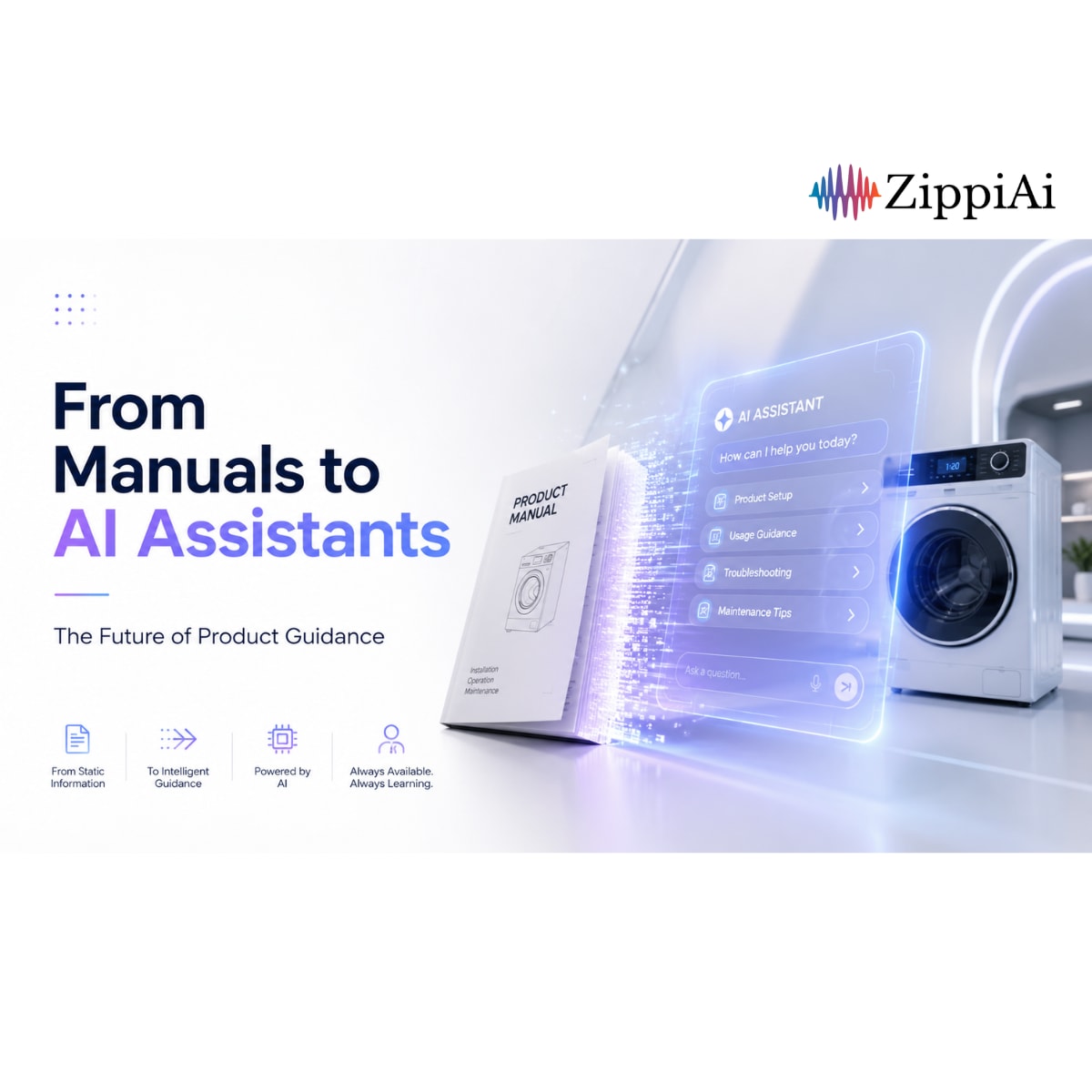
From Manuals to AI Assistants: The Future of Product Guidance
From Manuals to AI Assistants: The Future of Product Guidance
How forward-thinking manufacturers are replacing outdated support models with intelligent, always-on customer experiences.
The Manual Nobody Read
Picture this: A customer unboxes your product, powers it on, hits a snag during setup — and reaches for their phone. Not to find the manual. Not to call support. To search Google, scroll through Reddit threads, or watch a YouTube tutorial made by a stranger.
The printed manual? Still folded neatly in the box. The PDF on your website? Never downloaded.
This is the reality most manufacturers are reluctant to confront. According to research from the Technical Communication industry, fewer than 25% of consumers read product manuals before using a new device. And among millennials and Gen Z — the fastest-growing segment of consumer spending — that number drops even further. Customers today are not lazy. They are simply accustomed to faster, smarter, and more intuitive ways of getting answers.
The question for every manufacturer, brand manager, and product leader is not whether this shift is happening. It already has. The real question is: Are you building products that guide customers intelligently, or are you still relying on documentation that no one reads?
The Limits of the Traditional Support Model
For decades, the product guidance model has remained largely unchanged. A product ships with a manual. A customer support phone line handles complaints. A FAQ page on the website catches overflow. And when something goes wrong, the customer waits — on hold, for an email reply, or for a technician visit.
This model was built for a different era. It is reactive, slow, and deeply inefficient.
Consider what traditional product support actually costs. Industry estimates from Gartner suggest that live agent support interactions cost companies between $6 and $12 per contact — and many complex support calls run significantly higher. For consumer electronics brands handling millions of units, even a modest reduction in support volume translates to tens of millions of dollars in savings annually.
Beyond the financial toll, there is a deeper problem: customer frustration. A consumer who cannot figure out how to set up a smart home device in the first twenty minutes is far more likely to return it than one who receives immediate, contextual guidance. Poor post-purchase experience is one of the leading drivers of product returns — and in categories like consumer electronics and connected appliances, return rates can reach 15–20%.
The manual was never a great solution. It was simply the only solution available.
Modern Customers Have Redefined the Rules
The expectations customers bring to product experiences have been reshaped by digital-first companies. When someone books a ride, streams a show, or transfers money through an app, the experience is instant, intuitive, and frictionless. There is no manual. There is no waiting. The product guides them through everything in real time.
Those same customers — your customers — now carry those expectations into every purchase. When they buy a premium kitchen appliance, a connected fitness device, or a home security system, they expect the same quality of experience they get from software.
They want instant answers, not PDFs. They want contextual help, not generic FAQs. And they want support on their schedule — at 11 PM on a Sunday, not between 9 AM and 5 PM on weekdays.
This is not a minor shift in preference. It is a fundamental change in what product experience means. And for manufacturers, meeting this expectation is no longer a differentiator. It is quickly becoming the baseline.
Enter the AI Assistant: A New Paradigm for Product Guidance
Artificial intelligence is giving manufacturers the ability to do something that was never before possible: embed intelligent, conversational guidance directly into the product experience.
AI assistants — whether delivered through a mobile app, a QR code on the packaging, a smart display on the device, or a web interface — can engage customers from the moment they open the box. They can walk users through setup step by step, adapt to the customer's specific model and configuration, answer questions in plain language, and troubleshoot problems in real time.
Unlike a static manual or a scripted chatbot, modern AI assistants understand context. They know which product the customer owns, which step of setup they are on, what went wrong, and how to resolve it — all without requiring the customer to navigate menus or wait on hold.
Companies are now building dedicated AI companions for their products — purpose-built assistants trained on product knowledge, user behavior, and support data — to serve as an always-on guide throughout the customer's ownership journey. This moves the customer relationship far beyond the point of purchase.
This is not about replacing humans with machines. It is about making human support rarer, and far more valuable, by resolving the majority of common questions automatically and intelligently.
The Business Case: Why Manufacturers Are Investing in AI Guidance
The strategic benefits for manufacturers who adopt AI-powered product guidance are substantial and measurable.
Reduced Support Volume When customers can resolve setup and usage questions instantly through an AI assistant, the volume of inbound support tickets drops significantly. Brands that have deployed intelligent product assistants report reductions in contact center inquiries of 30–50% within the first year. That directly reduces operational cost at scale.
Faster Product Onboarding First impressions determine long-term product loyalty. AI assistants that guide customers smoothly through initial setup dramatically improve onboarding completion rates. A customer who successfully configures their product on day one is far more likely to use it consistently, recommend it to others, and repurchase from the same brand.
Better Customer Experience — at Every Stage AI guidance is not limited to the setup phase. Throughout the product lifecycle — whether a customer is learning a new feature, troubleshooting an issue, or preparing for maintenance — an AI assistant can provide relevant, timely support. This transforms the ownership experience from one that ends at unboxing to one that continues throughout the product's life.
Lower Operational Costs The math is straightforward. AI assistants handle inquiries 24 hours a day, across languages, without staffing costs, and at a fraction of the per-interaction cost of live support. For global brands managing customers across multiple time zones and languages, this scalability is a compelling advantage.
Stronger Customer Satisfaction and Loyalty Customer satisfaction scores are consistently higher when support is fast, accurate, and available on demand. A customer who gets an immediate, correct answer to their question at midnight rates their product experience more favorably — and is more likely to return.
Higher Product Adoption Many products ship with features that customers never discover or use. AI assistants can proactively surface relevant features based on usage patterns, increasing product adoption and perceived value. A customer who discovers and uses more of what they paid for is a satisfied customer.
What This Looks Like in Practice
Forward-thinking brands are already integrating AI guidance into their product ecosystems in tangible ways.
Home appliance brands are launching companion apps with built-in AI assistants that respond to natural language questions — "Why is my dishwasher leaving spots?" — and walk customers through solutions specific to their model, with images and step-by-step instructions.
Consumer electronics companies are embedding QR codes on packaging that launch guided setup experiences, dynamically adjusting based on what device the customer is setting up and what issue they report.
HVAC and industrial equipment manufacturers are deploying AI-powered diagnostic tools that technicians and end-users can query in real time, reducing field service visits by enabling remote resolution of common problems.
Smart fitness device brands are using AI to personalize onboarding — asking about the customer's goals, recommending features, and checking in at key moments during the first 30 days to ensure engagement and satisfaction.
In each case, the shift is the same: from reactive customer support to proactive customer guidance.
What the Next Five Years Will Look Like
The trajectory of AI in product guidance points toward an even more integrated future.
Predictive support will become standard — AI systems that identify potential problems before customers even notice them, based on device telemetry and usage patterns, and proactively reach out with solutions.
Multimodal AI assistants will allow customers to hold up their phone camera to a component and receive instant visual guidance — no serial number lookup, no navigating menus.
Voice-based product assistants will become common in connected home and industrial environments, enabling hands-free troubleshooting in contexts where typing is impractical.
And as AI systems learn from millions of customer interactions, product guidance will become increasingly personalized — adapting not just to the product, but to the individual user's experience level, language, and behavior.
For manufacturers, this means that product intelligence — how well a product guides and supports its owner — will become as important a differentiator as product quality itself.
The Future Belongs to Brands That Guide, Not Just Build
The manufacturers that will lead the next decade are not simply those who build the best products. They are those who create the best experiences around their products.
Customer expectations have moved decisively. Support is no longer a cost center to be minimized — it is a touchpoint that shapes brand loyalty, drives repurchase, and defines how customers remember you long after the sale is made.
AI assistants are not a futuristic concept. They are a present-day competitive advantage, being adopted by leading brands across every category of manufactured goods. The question for decision-makers today is not whether to invest in intelligent product guidance. It is how quickly you can move before the gap between you and your competitors becomes too wide to close.
The era of the ignored manual is over.
The future of manufacturing support is intelligent, instant, and always on — and the brands building that future are the ones customers will choose tomorrow.
The most successful manufacturers of the next decade will not be remembered for the products they built — but for how seamlessly those products understood, guided, and supported the people who used them.