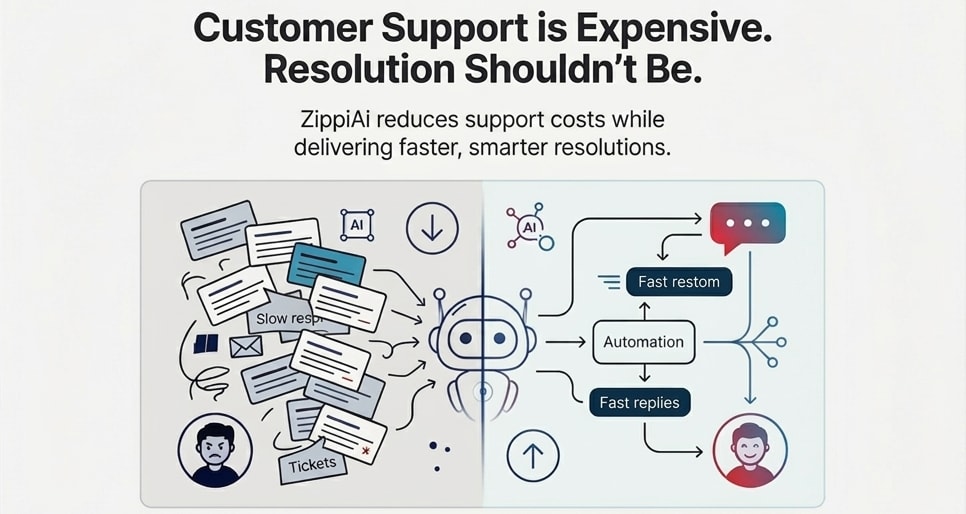
Chatbots Aren’t Fixing Customer Support. They’re Exposing Its Weakest Links
Chatbots Aren’t Fixing Customer Support. They’re Exposing Its Weakest Links
Chatbots have become the centerpiece of modern customer support strategies. From automated help centers to conversational interfaces embedded across digital touchpoints, companies are investing heavily in chatbot-driven self-service systems with the expectation that they will reduce costs, scale operations, and improve customer experience.
On the surface, this shift appears logical. Customers prefer faster resolutions, and businesses want to minimize dependency on human agents. However, recent findings highlighted in a report covered by Destination CRM reveal a stark disconnect between adoption and effectiveness.
- 73% of customers begin their support journey through self-service channels
- Only 14% fully resolve their issues through those channels
- Even for simple issues, resolution rates reach just 36%
These numbers point to a fundamental issue: self-service is widely used, but rarely successful.
The Illusion of Automation Success
Most organizations interpret the growth of chatbot adoption as a sign of success. Increased chatbot interactions, higher traffic to help centers, and reduced first-touch human involvement are often seen as positive indicators.
However, these metrics can be misleading.
Adoption does not equal resolution. In fact, high adoption combined with low resolution suggests that customers are being pushed into systems that fail to meet their needs. Instead of solving problems, these systems often delay resolution, forcing customers to escalate their issues through multiple channels.
This creates a layered experience:
- The customer starts with a chatbot
- Fails to find a relevant or accurate solution
- Moves to human support with increased frustration
- Requires more time and effort to resolve the issue
The result is not efficiency, but accumulated friction.
Understanding the Real Failure Points
The shortcomings of current chatbot systems are not primarily technological—they are structural and strategic.
The report highlights two critical gaps:
- 45% of customers feel companies do not understand their issue
- 43% struggle to find relevant answers
These insights reveal that the core problem lies in how chatbot systems interpret and respond to customer intent.
Most existing chatbot solutions operate on predefined workflows, keyword matching, or static knowledge bases. While these approaches work for highly standardized queries, they break down when customers express nuanced, context-dependent, or multi-layered problems.
In practice, this leads to:
- Misinterpretation of user intent
- Generic or irrelevant responses
- Over-reliance on rigid decision trees
- Limited ability to adapt to unique scenarios
Chatbots, when implemented superficially, do not solve these issues. They often amplify them by increasing the speed at which ineffective responses are delivered.
The Limitation of Chatbots
A critical distinction that many organizations fail to make is the difference between chatbots and true AI intelligence systems.
In many deployments, chatbots are treated as a thin interface layer added on top of existing processes. They are trained on existing FAQs, workflows remain unchanged, and knowledge bases are simply made searchable through conversational interfaces.
This approach leads to marginal improvements at best.
Chatbots are designed to handle queries.
They are not inherently designed to solve problems.
Where AI Intelligence Systems Actually Win
AI intelligence systems operate differently. They are not just conversational layers; they function as decision-making engines that drive outcomes.
Instead of relying on static flows, these systems:
- Interpret intent dynamically
- Learn from real interactions
- Integrate context across multiple data sources
- Continuously improve through feedback loops
The difference is significant. Chatbots automate existing inefficiencies, while AI intelligence systems restructure support around resolution.
The Concept of Resolution Design
To move beyond superficial automation, companies need to adopt what can be described as resolution design.
Resolution design focuses on ensuring that every customer interaction is structured to achieve a clear outcome: solving the problem as quickly and accurately as possible.
This involves several key principles:
1. Building from Real Interactions
Instead of creating knowledge bases in isolation, high-performing teams develop content directly from customer conversations. This ensures that solutions are aligned with how customers actually describe their problems.
2. Intent-Driven Systems
Rather than relying on keywords or fixed categories, advanced systems analyze intent at a deeper level. This allows them to handle variations in language, context, and complexity.
3. Flexible Journeys
Traditional support systems rely on rigid flows. Resolution-focused systems adapt dynamically, allowing customers to move fluidly based on their specific needs.
4. Continuous Optimization
Every unresolved query is treated as a signal. Systems are continuously updated to address gaps, improving resolution rates over time.
Business Implications: Beyond Support
The impact of ineffective chatbot-led self-service extends far beyond customer support metrics.
Unresolved issues directly influence:
- Customer retention: Frustrated users are more likely to switch providers
- Conversion rates: Poor support experiences reduce trust during the buying journey
- Brand perception: Repeated friction damages long-term brand equity
- Operational costs: Escalations increase the workload on human agents
In this context, customer support is not a cost center—it is a critical driver of revenue and growth.
Organizations that rely solely on chatbots without improving resolution may find that their investment leads to diminishing returns, as inefficiencies compound across the customer lifecycle.
Rethinking the Objective
The prevailing narrative around chatbots in customer support is centered on automation and cost reduction. While these are valid goals, they should not be the primary objective.
The more important question is:
How effectively are customer problems being resolved?
Shifting the focus from chatbot usage to resolution changes how success is measured. Instead of tracking interaction volume or deflection rates, organizations should evaluate:
- Resolution rates
- Time to resolution
- Customer satisfaction post-interaction
- Reduction in repeat queries
This shift aligns support systems more closely with business outcomes.
Conclusion
Chatbots have played an important role in scaling customer support, but their limitations are now becoming increasingly clear.
The gap between self-service adoption and resolution highlights a deeper issue: the problem is not the absence of technology, but the absence of effective system design.
Chatbots do not inherently improve customer experience. They amplify the strengths and weaknesses of the systems they operate within.
AI intelligence systems, when implemented correctly, offer a path forward by focusing on outcomes rather than interactions.
The future of customer support will not be defined by how many chatbots are deployed, but by how effectively systems are designed to solve real customer problems.
Organizations that recognize this distinction will move beyond surface-level automation and build support systems that deliver measurable impact.