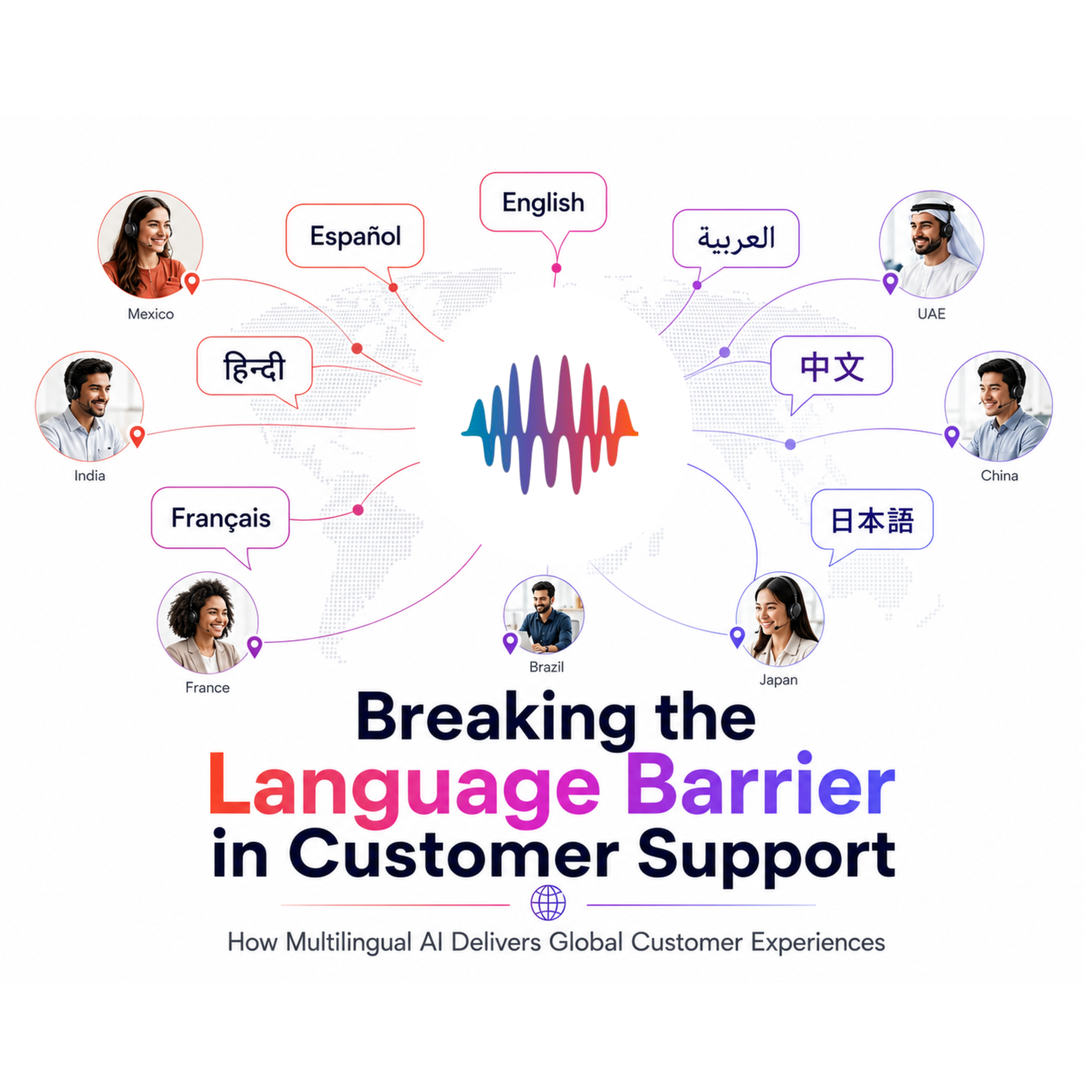
Breaking the Language Barrier in Customer Support with Multilingual AI
Your product ships globally. Your support probably doesn’t. Here’s how AI closes that gap — in any language.
Meta description: Multilingual AI is reshaping global customer support. Learn why language gaps cost revenue, why traditional support models can’t scale, and how Voice AI Companions deliver consistent, multilingual customer experiences.
A consumer electronics brand can launch a new product in forty countries within a single quarter. Manufacturing scales. Logistics scale. Marketing localizes overnight. Ask the same company how many of those forty markets have customer support in the local language, though, and the number drops sharply — often to three or four.
That’s the quiet contradiction sitting inside most global growth strategies. Products move at the speed of supply chains and app stores. Support, historically, moves at the speed of hiring. The mismatch used to be a minor operational footnote; it no longer is. As customer expectations rise and AI matures into something genuinely conversational, language is becoming one of the clearest dividing lines between brands that scale customer experience well and brands that scale it on paper only.
Global products are easy to distribute. Global customer support is hard to scale. Multilingual AI is emerging as the mechanism that closes that gap — not by translating words, but by understanding customers.
The Hidden Cost of Language Barriers
Language friction rarely shows up as one dramatic failure. It shows up as a slow leak across the metrics CX leaders already track: resolution times that stretch when a customer repeats themselves in broken English, escalations that spike because a frustrated customer pushes harder through another channel, CSAT scores that dip in markets where support exists in name but not substance, and renewal conversations that quietly suffer because dissatisfied customers rarely complain — they just don’t come back.
The data backs this up. Research shows 76% of online shoppers prefer buying from sites with information in their native language, and 40% will never buy from a site that doesn’t offer it. CSA Research has found the same preference extends to support: 76% of consumers prefer brands offering native-language care, and 75% are more likely to repurchase from brands that provide it.
Consider a customer in São Paulo whose smart home device misconfigures, and whose only support option is an English-language bot that misreads “não está funcionando” as a cancellation request. That customer doesn’t leave an angry review. They just stop using the product. Language barriers aren’t a service inconvenience — they’re a revenue and retention problem wearing a communication disguise. Nearly three in ten companies report losing business specifically to language-related misunderstandings, a figure that should concern any CFO, not just the head of support.
Why Traditional Support Models No Longer Scale
For two decades, enterprises solved the multilingual problem three ways: hire multilingual agents, outsource to regional contact centers, or build IVR menus that route callers by language. Each worked at a certain scale. None works at the scale most enterprises now operate at.
Hiring sounds simple until you try staffing twelve languages across four time zones; sourcing native or C1-level speakers is rarely as easy as it sounds, and retention is its own ongoing cost. Outsourcing solves staffing but introduces inconsistency, since brand voice is hard to manage across vendors serving multiple clients from shared agent pools. IVR menus solve almost nothing for the customer — they route a call correctly, occasionally, without resolving anything. And manual translation workflows add latency exactly when a frustrated customer wants speed.
The common thread: each model trades one constraint for another. Lower-cost options sacrifice consistency; higher-quality ones sacrifice scalability. None were built for a world where a single product ships to sixty markets on day one.
The Rise of Multilingual AI
What’s changed isn’t that AI learned to translate better — it’s that AI learned to understand better, and that distinction matters more than it sounds. Translation converts words from one language to another. Understanding extracts intent regardless of the words used to express it. Modern multilingual AI pairs natural language understanding with real-time speech recognition, parsing what a customer is trying to accomplish in the language they’re most comfortable using, accent and phrasing included.
That’s why intent detection and context retention matter as much as the underlying language model. A customer who reports a washing machine that “makes a strange noise during spin cycle” and one who says “lavadora hace ruido raro” are describing the identical problem. A system built only to translate produces two correct sentences. A system built to understand recognizes one service request and routes both customers toward the same resolution — no manual mapping required.
Beyond Translation: Understanding Human Conversations
Here’s where most multilingual systems still fall short: customers don’t speak in clean, single-language sentences. They code-switch mid-sentence, mix regional dialects with national languages, and use colloquial phrases that sound absurd translated literally.
A customer in Mumbai might open in Hindi, switch to English for “warranty extension,” and close in Hinglish. A customer in Quebec might use French vocabulary with English sentence structure. None of this is unusual — it’s simply how multilingual populations talk, and any AI Companion built around rigid, single-language assumptions will misfire constantly against that reality.
Systems built for this treat code-switching as the norm rather than the exception, holding context across the switch instead of resetting with each change. The goal isn’t linguistic perfection; it’s recognizing what the customer needs even when they express it informally, imperfectly, or across three languages in one sentence. That’s a harder problem than translation, and it’s the one that determines whether a customer feels understood or feels like they’re talking to a phrasebook.
Why Consumer Electronics Brands Need Multilingual AI
Few categories make the stakes more concrete than consumer electronics. A smart TV that won’t pair with a home network, an air conditioner displaying an unfamiliar error code, a refrigerator whose app won’t sync, a washing machine spinning unevenly — these are the constant, unglamorous realities of owning connected appliances. Unlike a SaaS product with a single technical user, electronics support serves entire households: a grandparent troubleshooting a smart speaker, a teenager configuring a router, someone calling from a kitchen with a half-installed dishwasher and limited patience.
Installation support, warranty inquiries, service scheduling, and basic product education make up most of these interactions, and almost none require complex judgment — just fast, patient communication in the customer’s language. A brand selling refrigerators across Southeast Asia doesn’t need fluent agents in Thai, Vietnamese, Bahasa, and Tagalog staffed around the clock. It needs a support layer that can walk a customer through a water filter replacement in whichever language they’re comfortable with, at 11 p.m. on a Tuesday, without a hold queue.
This is where multilingual Voice AI changes the resolution math. A setup question resolved instantly, in-language, rarely escalates. A warranty inquiry answered without a transfer rarely becomes a complaint. The ceiling on resolution rates in consumer electronics has historically been set by language coverage and staffing hours — constraints AI removes almost entirely.
Customer Support as a Source of Product Intelligence
There’s a second, less obvious value inside every support conversation: information about the product itself. Every call or chat contains signal — feature requests buried in complaints, usability friction customers describe but never formally report, regional preferences that emerge as patterns once conversations are aggregated, and sentiment shifts that show up before churn does. Support teams have always sensed this informally. What’s changed is the ability to capture it at scale.
When conversations happen in twelve languages across six regions, that intelligence has historically been hardest to surface, not because the signal is absent, but because no one has the bandwidth to read transcripts in languages they don’t speak. A multilingual AI Companion removes that bottleneck, recognizing that “the app keeps logging me out” in English and its French equivalent are the same product issue showing up in two markets, and surfacing that as one prioritized signal for the product team instead of two disconnected tickets.
Support stops being a cost center that simply closes tickets and becomes a structured feedback loop feeding the product roadmap directly. The insight was always there; what was missing was the infrastructure to listen at scale, in every language customers actually speak.
How ZippiAI Enables Multilingual Customer Engagement
This is the layer ZippiAI was built to operate in. Its Voice AI Companions hold natural, real-time conversations with customers across multiple languages, without the rigid scripting that made older IVR and chatbot systems feel like talking to a phone tree. Because the Companions operate continuously, enterprises gain coverage that doesn’t depend on staffing schedules — a customer in Manila and one in Madrid get the same quality of response at 3 a.m. local time as at 3 p.m., a consistency that’s structurally difficult for human-staffed models to replicate at any budget.
The outcomes that matter to enterprise leaders follow from that consistency: support costs that scale sub-linearly with customer growth rather than tracking headcount, customer experience that holds steady across markets instead of degrading the farther a market sits from headquarters, and product intelligence that becomes usable instead of lost in untranslated transcripts. The case for CX leaders isn’t that AI replaces human support — it’s that AI removes language as the constraint quietly capping how well human support could ever scale.
The Future of Customer Support
Voice is re-emerging as a preferred interface precisely because it’s the most natural way humans communicate, and AI has finally caught up to making voice interactions fast rather than frustrating. Customers increasingly expect support personalized to them — their language, their product, their history with the brand — not personalized to whichever agent happens to pick up.
As organizations expand into new markets, multilingual support is shifting from a nice-to-have to a competitive necessity, faster than most support roadmaps account for. What looks like a differentiator today reads very differently in eighteen months, once it’s simply the baseline customers assume every serious global brand has already met.
Conclusion
The brands that win globally won’t simply sell products in more countries. They’ll build customer experiences that speak every customer’s language — not as a translated afterthought, but as a structural part of how the business operates. Multilingual AI is the infrastructure that makes that possible at a scale no hiring plan or outsourcing contract ever could.