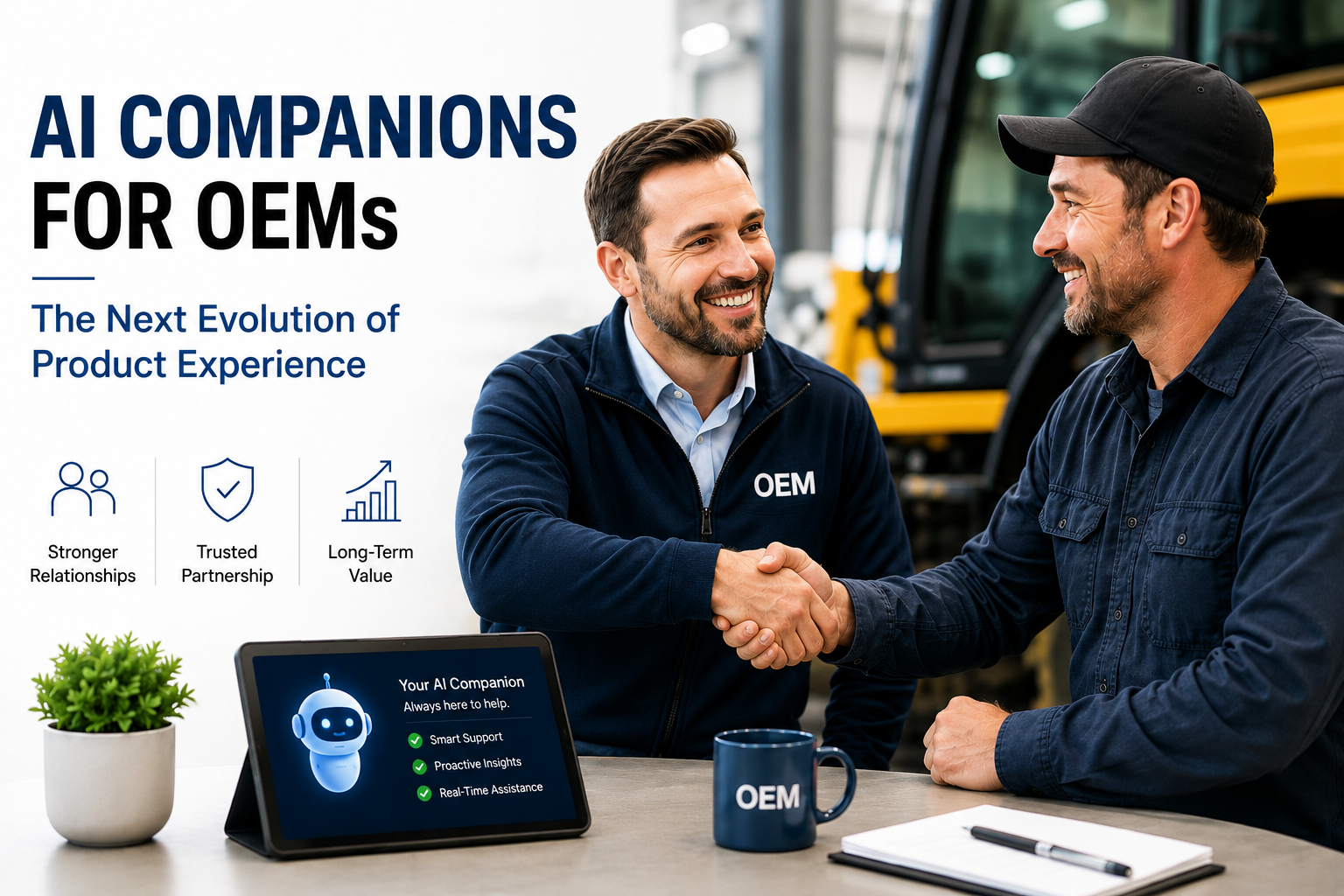
AI COMPANIONS FOR OEMs
Introduction
For most of the twentieth century, OEM manufacturers competed on a single axis: the quality of the product that left the factory floor. Engineering precision, materials science, supply chain efficiency, and cost optimization were the levers that determined market leadership. The experience a customer had after buying the product — the setup, the troubleshooting, the long-term ownership journey — was considered secondary, largely delegated to printed manuals, third-party retailers, and overworked call centers.
That calculus has fundamentally changed. In today’s market, where product specifications converge and switching costs are lower than ever, the post-purchase experience has become a primary driver of brand loyalty, repurchase intent, and Net Promoter Score. According to Gartner, more than two-thirds of companies now compete primarily on customer experience — a figure that has more than doubled in the past decade. For OEM manufacturers, this shift is not abstract: it is reshaping how brands invest, differentiate, and grow.
At the center of this transformation is a new category of technology: AI Companions. Distinct from traditional chatbots, static FAQs, or legacy IVR systems, AI Companions are intelligent, conversational, product-aware systems capable of guiding customers through every stage of product ownership — from first setup to long-term troubleshooting, usage optimization, and proactive engagement. For OEM manufacturers navigating rising support costs, complex global customer bases, and relentlessly rising customer expectations, AI Companions represent not just an operational improvement, but a fundamental rethinking of what it means to support a product.
The Evolution of Product Experience
To understand why AI Companions matter, it helps to trace the arc of how OEMs have historically attempted to support their customers. Each era introduced a new tool — and each, in turn, revealed its own limitations.
The printed manual was the first generation of product support — comprehensive in theory, inaccessible in practice. Customers rarely read them in full. When problems arose, the manual’s linear structure made it poorly suited to the non-linear reality of troubleshooting. Call centers followed, offering human expertise but at enormous cost and with significant latency — long hold times and inconsistent resolution quality eroded customer trust just as often as they rebuilt it.
The internet era brought knowledge bases, FAQs, and mobile apps — digital improvements that expanded access but placed the burden of navigation on the customer. Chatbots, arriving with considerable fanfare in the mid-2010s, promised natural language interaction but largely delivered scripted, rule-based responses that frustrated users more often than they helped. The gap between what customers needed and what these systems could deliver remained wide.
AI Companions mark the next generation. Powered by large language models and trained on product-specific knowledge, they can understand intent, hold context across a conversation, switch between languages, and provide genuinely useful guidance in real time. They represent the first product support technology that can plausibly replicate the experience of speaking with an expert who both knows the product deeply and understands the customer’s specific situation.
Why OEMs Are Rethinking Customer Support
The pressures driving OEMs toward AI-powered customer support are structural, not cyclical. They will not ease with the next product refresh or cost-cutting initiative.
Rising support costs are the most immediate challenge. As product lines expand and customer bases globalize, support ticket volumes grow non-linearly. A mid-sized consumer electronics brand managing support across six markets can easily field hundreds of thousands of contacts annually — each one requiring trained agents, quality control infrastructure, and escalation pathways. For appliance manufacturers, where product complexity has increased dramatically with the integration of smart home connectivity, the cost and complexity of support has risen in parallel.
Language and cultural fragmentation compound the problem. A printer manufacturer distributing products across Southeast Asia, the Middle East, and Latin America faces the near-impossible task of staffing native-language support teams for dozens of markets simultaneously. Multilingual customer support at scale has historically required either significant investment or painful quality compromises. Neither outcome is sustainable as global distribution expands.
Meanwhile, customer expectations — shaped by the on-demand immediacy of consumer apps and digital services — have created a new benchmark that legacy support systems simply cannot meet. A customer troubleshooting a connected appliance at 11 p.m. does not want to wait until business hours to speak with an agent. A first-time buyer of a professional camera system does not want to navigate a 120-page manual to find the answer to a single setup question. The expectation is instant, accurate, conversational support — available wherever and whenever the customer needs it.
For industrial equipment manufacturers and automotive brands, the stakes are even higher. A field technician unable to resolve an equipment malfunction quickly faces not just customer dissatisfaction, but operational downtime with direct financial consequences. Support speed and accuracy are not convenience factors in these sectors — they are core business requirements.
What Are AI Companions?
An AI Companion, in the OEM context, is an intelligent, product-aware conversational system that can engage customers across text, voice, and digital channels to provide guidance, support, and personalized assistance throughout the product lifecycle. The term is deliberately distinct from earlier categories — because the distinctions matter.
Traditional chatbots operate on decision trees — structured scripts that route customers through predefined pathways. They fail gracefully only when the customer’s question fits neatly within those trees, which real-world support interactions rarely do. FAQ systems are static repositories that require customers to do the work of navigation and retrieval — a poor fit for customers in the middle of a frustrating product problem. IVR systems, despite decades of refinement, remain symbols of corporate indifference to most customers.
AI Companions are fundamentally different in four dimensions. First, they understand natural language — customers can express their issue as they would to a human expert, without learning system-specific vocabulary or navigating menu hierarchies. Second, they are product-specific: trained on a manufacturer’s complete knowledge base, documentation, and support data, they provide accurate, contextually relevant answers rather than generic responses. Third, they maintain conversational context — if a customer mentions that their device was recently updated before describing a connectivity problem, the AI Companion factors that into its guidance, just as a skilled human agent would. Fourth, they operate across languages seamlessly, enabling true multilingual global support without the staffing overhead it has historically required.
How AI Companions Transform Product Experiences
Intelligent Product Onboarding
The unboxing and setup experience is where product love — or frustration — is often established. AI Companions can guide customers through first-time setup with the adaptive patience of a dedicated support specialist: asking clarifying questions, adjusting instructions based on the customer’s technical comfort level, and proactively addressing common stumbling points before they become problems. For smart appliance manufacturers, where setup complexity has grown with IoT integration, this kind of intelligent product onboarding can meaningfully improve first-use success rates and reduce early-return rates.
Instant Troubleshooting
When something goes wrong with a product, customers want a resolution — not a journey through static knowledge bases or hold queues. AI Companions enable intelligent troubleshooting in real time, walking customers through diagnostic steps conversationally and adapting the guidance based on the customer’s responses. A consumer electronics brand, for example, could deploy an AI Companion that handles the top fifty common support scenarios autonomously — resolving the majority of contacts without agent involvement, while escalating complex or sensitive issues with full context preserved.
Voice-Based Assistance
Voice AI for manufacturers represents one of the most significant near-term opportunities in customer experience. Voice interactions are more natural, faster, and more accessible than text-based channels — particularly for customers in situations where typing is impractical, such as during appliance installation or equipment operation. Conversational AI for manufacturers, delivered through voice interfaces, can transform product support from a reactive, friction-heavy experience into something genuinely useful and ambient.
Multilingual Global Support
For OEMs with global distribution, language has historically been both a priority and a constraint. AI Companions can engage customers fluently across dozens of languages — providing the same quality of intelligent troubleshooting and product guidance regardless of whether a customer is in Chennai, Cairo, or São Paulo. This is not machine translation layered over a rigid script; it is genuinely multilingual AI that understands regional context, idiomatic usage, and local product variants. The cost and speed advantages over traditional multilingual staffing models are significant.
Proactive Customer Engagement
Perhaps the most underappreciated capability of AI Companions is their ability to shift manufacturer-customer interactions from reactive to proactive. Rather than waiting for customers to encounter a problem and initiate contact, AI Companions can proactively reach out with usage tips, maintenance reminders, firmware update notifications, and personalized guidance based on actual usage patterns. For a home appliance brand, this might mean reminding a customer to descale their coffee machine before it affects performance. For an industrial equipment manufacturer, it might mean flagging an anomalous usage pattern that predicts a component failure before downtime occurs.
Real-World Applications Across OEM Industries
The practical applications of AI Companions vary meaningfully by sector — and the business outcomes available to early movers are substantial.
Consumer Electronics
A leading television manufacturer deploying an AI Companion could handle the majority of post-purchase contacts — setup guidance, connectivity troubleshooting, smart home integration questions — without human agent involvement. More importantly, the AI Companion could identify patterns across millions of support interactions that reveal design or usability issues in specific product models, feeding actionable intelligence back into product development cycles.
Home Appliances
An appliance brand managing a range of connected kitchen and laundry products could use AI Companions to deliver personalized usage guidance — suggesting optimal wash cycles based on fabric types detected by sensors, or guiding customers through error codes with step-by-step corrective actions. Proactive maintenance alerts, delivered conversationally through a companion interface, could reduce warranty claim rates and extend product lifespan.
Printers and Imaging Products
Printer manufacturers face one of the highest support contact rates in consumer electronics. AI Companions could address the most common contact drivers — driver installation, network connectivity, consumable replacement — with zero agent involvement, while providing a native-language experience for customers across global markets without additional staffing cost.
Industrial Equipment
For industrial equipment manufacturers, AI-powered product support can play a critical role in reducing field service costs and improving equipment uptime. A voice-accessible AI Companion integrated with a piece of industrial machinery could guide a field technician through diagnostic protocols in real time — providing the institutional knowledge of an expert without the latency of scheduling a service visit.
Automotive Manufacturers
Automotive OEMs are already experimenting with in-vehicle AI assistants for navigation and infotainment support — but the opportunity extends further. AI Companions integrated with connected vehicle platforms could provide proactive maintenance guidance, interpret dashboard alerts conversationally, and personalize the driving experience based on individual usage patterns — transforming the vehicle from a product into a continuously evolving, intelligent experience.
Business Benefits for OEM Manufacturers
The business case for AI Companions in OEM manufacturing is both immediate and compounding. In the near term, the operational benefits are significant: research from McKinsey suggests that AI-powered customer service automation can reduce per-contact support costs by 30 to 50 percent, while simultaneously improving first-contact resolution rates. For manufacturers managing high-volume support operations across multiple markets, these figures represent material P&L impact.
Beyond cost reduction, AI Companions drive improvements in customer satisfaction and retention — metrics that translate directly into revenue. Faster issue resolution reduces customer frustration and the likelihood of returns. Better product onboarding improves feature adoption and perceived product value. Proactive engagement deepens the relationship between customer and brand, increasing repurchase intent across the product lifecycle.
There is also a strategic data asset being created in every AI Companion interaction. The aggregate intelligence derived from millions of customer conversations — the questions asked, the features explored, the problems encountered — represents an unprecedented source of product intelligence. Manufacturers that can systematically analyze this data will gain a structural advantage in product development, quality management, and go-to-market strategy.
Finally, AI Companions provide something that has historically been impossible at scale: consistent, high-quality support across every market, language, and channel simultaneously. The scalability of AI-powered customer support means that a manufacturer’s support capability grows with its business — not ahead of it, as staffing would require, or behind it, as human hiring cycles typically produce.
The Future of Product Experience
The trajectory of AI Companions in OEM manufacturing points toward an increasingly embedded, personalized, and predictive model of product experience — one where the distinction between the product and the support infrastructure around it begins to dissolve.
Embedded AI assistants — built directly into connected products rather than accessed through external apps or websites — will become a standard feature expectation for premium product lines within the next few years. Voice-first support, already normalized by consumer voice assistants, will extend naturally into the product ownership context, enabling hands-free guidance during installation, maintenance, and troubleshooting. Predictive maintenance capabilities, drawing on real-time IoT data from connected products, will allow AI Companions to identify and address potential failures before they manifest — shifting after-sales service automation from reactive resolution to proactive care.
At the frontier of this evolution is the concept of the personalized product ecosystem — an intelligent, AI-mediated relationship between a customer and their entire portfolio of a manufacturer’s products. An OEM that can deliver a seamless, intelligent, cross-product experience — where the AI Companion understands not just a single device but the customer’s complete product environment and usage patterns — will have built a form of customer relationship depth that is genuinely difficult to replicate.
Generative AI for manufacturing will also enable a new generation of AI Companions that can synthesize product knowledge dynamically — adapting to new product releases, regulatory changes, and regional requirements without the lengthy retraining cycles that earlier AI systems required. This will allow manufacturers to deploy AI Companions at scale across their full product catalog, rather than limiting deployments to flagship products or high-volume models.
Taken together, these trends point toward a future in which the connected product experience — intelligent, continuous, personalized, and proactive — becomes the primary battlefield for OEM differentiation. Manufacturers that invest in this capability now will build the institutional knowledge, customer data assets, and brand relationships that compound over time. Those that do not will find themselves competing on specifications and price in an increasingly commoditized market.
Conclusion
For decades, the OEM manufacturing industry organized itself around a compelling but ultimately incomplete idea of what it meant to deliver a great product. Engineering excellence, supply chain efficiency, and cost competitiveness were necessary conditions for success — but they are no longer sufficient. The customers who buy OEM products today expect more: not just a device that works, but an ownership experience that is intelligent, responsive, and continuously valuable.
AI Companions are the technology category that makes this new standard achievable at scale. They bridge the gap between the product as manufactured and the product as experienced — transforming what has historically been a cost center into a source of genuine competitive advantage.
“The next generation of OEM leaders will not compete solely on product quality. They will compete on how intelligently, seamlessly, and continuously they support customers throughout the product lifecycle.”
The shift underway is not a technology trend to be monitored from a distance. It is a structural change in how customers evaluate, choose, and remain loyal to the brands behind the products they depend on. AI Companions are the mechanism through which forward-thinking OEM manufacturers will build those relationships — at scale, in every language, across every market, for the full lifetime of every product they make.
The question for OEM executives and customer experience leaders is no longer whether to invest in this capability. It is whether to lead the transition or follow it.
About ZippiAI
ZippiAI is an enterprise Voice AI company building Aura — an AI Voice Companion purpose-built for OEM manufacturers, consumer electronics brands, and appliance companies. Aura delivers intelligent, multilingual, voice-powered customer support and engagement across the full product lifecycle, helping manufacturers reduce support costs, improve customer satisfaction, and build stronger, longer-lasting relationships with their customers.