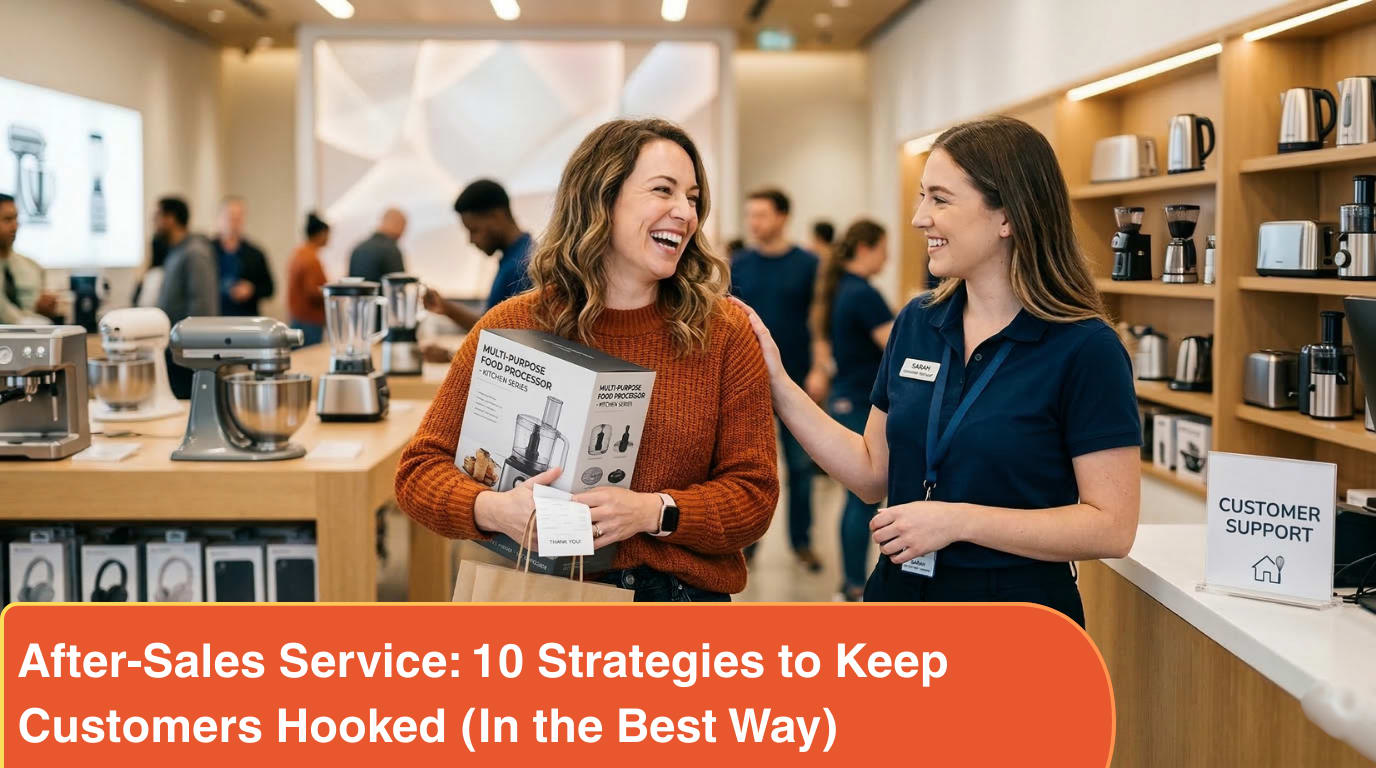
After-Sales Service: 10 Strategies to Keep Customers Hooked (In the Best Way)
By ZippiAI Team | Customer Success & Growth | 13 min read
Pop the champagne — you just closed the deal! Go ahead, do a little victory dance in your chair. You've earned it. But before you mentally check that client off your list and ride off into the sunset of new prospects, we have some news: the real work is just getting started.
Here's a fun little reality check for you: acquiring a brand-new customer costs anywhere from 5 to 25 times more than keeping an existing one. And if you invest just 5 percent more effort in customer retention, you can boost profits by a minimum of 25 percent. In other words, the customer you already have is basically a golden goose — and after-sales service is how you keep it clucking.
In this guide, ZippiAI walks you through everything you need to know about after-sales service: what it actually is, why it matters more than your morning coffee, and 10 concrete activities that will make your customers feel so valued they'll be recommending you to their grandparents.
What Is After-Sales Service?
After-sales service is the ongoing support, care, and attention you provide to customers once a purchase has been made. Think of it like this: the sale is the first date, but after-sales service is the relationship. And as anyone who has ever been ghosted after a first date knows — disappearing is not a winning strategy.
Great after-sales service can look like many things: answering product questions promptly, providing onboarding or setup support, creating loyalty programs, or even sending a heartfelt thank-you note. The through-line in all of these actions? Showing your customers that you value them as people, not just as payment transactions waiting to clear.
Why Post-Sale Service Is a Big Deal (No, Really)
Sales teams are, naturally, wired to chase new deals. There's an undeniable thrill to converting a fresh lead. But here's what the data tells us, and data doesn't lie (unlike that one colleague who says they 'almost' hit their quota):
The probability of selling to an existing customer is 60 to 70 percent. The probability of selling to a brand new prospect? Just 5 to 20 percent.
Those aren't just numbers — those are odds that would make a Vegas bookmaker smile. Existing customers already trust you, already know your product, and are already willing to open their wallets again. You just have to give them a reason to.
Beyond driving repeat sales, exceptional after-sales service delivers a cascade of business benefits:
• Dramatically improved customer satisfaction scores
• Stronger, longer-lasting brand loyalty
• Higher customer retention rates
• Repeat purchases and upselling opportunities
• Elevated brand reputation and perceived value
• A flood of word-of-mouth referrals (the best kind of marketing, and the cheapest)
All of these outcomes feed into one critical metric: customer lifetime value. The longer a customer stays with you, and the more they buy from you, the more valuable they become to your business. After-sales service is the engine that drives that value higher.
10 After-Sales Activities That Actually Work
Ready to wow your customers so thoroughly they forget your competitors even exist? Here are ten proven tactics ZippiAI recommends for supercharging your post-sale game.
1. Send a Personalized Thank-You
Remember when your grandma used to send birthday cards with a crisp five-dollar bill inside? You remembered it for years, right? That's the power of a personal, heartfelt gesture. In today's world of automated notifications and generic 'Your order has been processed' emails, a genuine thank-you stands out like a neon sign in a fog bank.
It doesn't have to be elaborate. A handwritten note, a personalized email, or even a quick phone call can make a customer feel genuinely appreciated. You can build this into your workflow so it becomes a natural, automated step in your sales process — just make sure the message itself feels human and not like it was written by a robot having an off day.
Never underestimate a sincere 'thank you.' It's two words that cost nothing and return everything.
2. Cross-Sell with Thoughtful Add-Ons
'Cross-sell' sometimes gets a bad reputation — it conjures images of pushy salespeople trying to upsell you on a warranty for a $4 stapler. But when done right, cross-selling is genuinely helpful.
Think about it from the customer's perspective: they just bought a beautiful espresso machine. Wouldn't they love to know about your premium coffee grinder? Or the exclusive subscription to single-origin beans? Pairing products intelligently improves the customer's overall experience and ensures they're getting maximum value from their purchase.
The key is relevance. Suggest add-ons that complement what your customer already bought, not just whatever has the highest margin. Customers notice the difference between being helped and being sold to.
3. Provide Proper Product Training Materials
There is absolutely nothing more frustrating than buying something exciting and then staring blankly at the instructions like they're written in ancient Sumerian. Don't be that brand.
Make it easy for customers to get the most out of what they've purchased from day one. Offer video tutorials, step-by-step setup guides, FAQ pages, or even live onboarding sessions with a specialist. For physical products, clear, well-designed installation manuals are non-negotiable — and yes, those lovable IKEA stick figures exist for a reason.
By proactively equipping your customers with the knowledge to use your product confidently, you dramatically reduce frustration, support tickets, and the dreaded one-star review that starts with 'I have no idea how to use this.'
✨ ZippiAI Aura: Give Every Product Its Own AI Expert
What if your product could train customers itself — in their own language, at 3 a.m., without a single support ticket? That's exactly what ZippiAI Aura does.
ZippiAI Aura is an Intelligent Product Companion platform that lets manufacturers and businesses build AI agents — trained entirely on their product knowledge — and deploy them on any device, appliance, or piece of machinery. Think of it as giving every single product you sell its own dedicated AI expert, one that never sleeps, never loses patience, and never says 'have you tried turning it off and on again?' without also explaining exactly why that works.
Here's what makes Aura genuinely different from a help article or a PDF manual no one reads:
• Guided Onboarding from Day One: Aura walks new customers through setup, feature discovery, and first-use confidence — proactively, not reactively. No more confusion out of the box.
• Built-in Safety Instructions: Whether it's industrial machinery, a power tool, or a kitchen appliance, Aura delivers contextual, model-specific safety guidance in plain language. No jargon, no skipped steps, no 'refer to page 47 of your manual.'
• Conversational Troubleshooting: Customers simply describe the problem in natural language — a blinking light, a strange noise, an error code — and Aura diagnoses and guides them through the fix instantly. No hold music. No 47-step troubleshooting PDF.
• 24/7 Multilingual Support: Aura speaks the language of your customers — literally. Full multilingual support means geographical and language barriers never stand between your customer and the help they need.
• Rich Product Insights: This is the part that makes product teams especially happy. Every interaction a customer has with Aura generates data — usage patterns, recurring pain points, most-asked questions, common failure modes. Aura captures it all and surfaces actionable insights so your engineering, CX, and product teams can fix issues faster and build smarter.
Aura learns and improves with every single customer interaction. The more your customers talk to it, the smarter it gets — building a living, self-improving knowledge base that reflects real-world usage of your product, not just what the spec sheet says.
Imagine shipping every product with an experienced service engineer already inside it — one who knows your exact model, speaks your customer's language, and gets smarter every day. That's Aura.
From home appliances and consumer electronics to industrial CNC machines and medical devices, Aura adapts to any product category. And the setup? Manufacturers can deploy a fully trained AI product companion in just a few clicks — no coding required, no months-long implementation, no army of support staff needed.
In short: if product training materials used to be a folder of PDFs your customers never opened, ZippiAI Aura is what they actually needed all along.
→ Explore ZippiAI Aura at zippiai.com/aura
4. Offer Robust Support Services
Things will go wrong. It's not pessimism; it's physics. The question isn't whether a customer will ever have a problem — it's whether your support infrastructure is ready when they do.
Make it effortless for customers to reach you. Different customers have different preferences: some want to call a real human being and hear a calm voice; others prefer live chat; still others just want to type a question into a search bar and solve the problem themselves at midnight in their pajamas. Cater to all of them.
More than two-thirds of consumers equate a great customer service experience with a fast resolution. Speed is not a bonus feature — it is the feature.
A stunning 95 percent of consumers say that customer service quality influences their loyalty to a brand. That's nearly everyone. When customers reach out, make sure they find fast, friendly, and effective support waiting for them.
5. Upgrade Your Packaging
Packaging might feel like a superficial concern in the grand scheme of after-sales strategy — but tell that to the tens of thousands of people who watch unboxing videos on YouTube every single day.
The moment a customer opens your package is an experience — and experiences are memorable. A plain cardboard box will get the product there, sure, but a beautifully designed, thoughtful package tells your customer that you care about every touchpoint of their journey with your brand.
Bonus tip: eco-friendly packaging is no longer just a 'nice to have' — it's increasingly a deciding factor for customers. Minimalist, sustainable packaging reduces your environmental footprint and resonates with a growing audience of environmentally conscious buyers. And it's a great story to tell.
6. Actively Seek Customer Feedback
Flying blind is not a business strategy. If you're not regularly asking your customers how they feel about your product and service, you have no idea whether you're delighting them or quietly driving them toward your competitors.
Send follow-up surveys with targeted questions. If you want to measure referral likelihood, ask about that specifically — don't muddle the data with unrelated questions. Keep surveys short, purposeful, and easy to complete. A small incentive (like a discount off their next purchase) can significantly boost response rates while also nudging customers toward another transaction.
The feedback you collect is pure gold. It tells you exactly where you're winning and where there's room to grow — no guesswork required.
7. Fix Mistakes Fast and Generously
Here's a counterintuitive truth about customer relationships: how you handle a problem can actually make a customer more loyal than if nothing had gone wrong in the first place. A well-handled mistake becomes a story customers tell with admiration. A poorly handled mistake becomes a one-star review with a novel-length description.
When things go sideways, respond quickly, apologize sincerely, and be generous in making things right. Replace the wrong item. Throw in something extra. Make it so easy to return or exchange a product that customers feel zero friction and maximum care. People remember how you made them feel when things weren't perfect. Make sure that memory is a good one.
8. Build a Loyalty Program Worth Joining
Not all loyalty programs are created equal. A poorly designed one feels like a chore. A great one makes customers feel like VIPs who are genuinely being rewarded for sticking around.
Research shows that loyalty program members spend up to 18 percent more than non-members. That statistic alone should be enough motivation to design something truly compelling. Points systems, tiered perks, exclusive early access to new products, free add-ons — there are countless ways to make loyal customers feel special. The important thing is that the rewards are genuinely valuable, not just a thinly veiled excuse to collect email addresses.
Ask yourself: would you actually want to join your own loyalty program? If the answer isn't an enthusiastic yes, it's time to redesign it.
9. Capitalize on Event-Focused Offers
There's one thing even the most unpredictable market can't take away from you: birthdays always happen. Holidays always come around. And your customers notice when brands they love take a moment to acknowledge the moments that matter.
A timely 'Happy Birthday' message with a small discount feels personal and warm. A holiday promotion keeps your brand front of mind during high-spending seasons. A back-to-school reminder at the right moment can trigger a purchase that might otherwise never happen.
The beauty of event-based outreach is that it's highly automatable. Set it up once in your CRM, and let it run. Your customers feel the personal touch without you lifting a finger every time.
10. Ask for Referrals — Don't Be Shy
Here's a jaw-dropping statistic: 91 percent of happy customers are willing to provide a referral. But only 11 percent of salespeople ever ask for one. That is an enormous, completely free opportunity being left on the table every single day.
Customers who arrive through word-of-mouth referrals are four times more likely to make a purchase. They come pre-warmed, pre-trusting, and pre-sold on your brand. All it takes is a simple, genuine ask — and a little incentive to sweeten the deal, like a discount code or a small gift for successful referrals.
Start asking. Seriously. Your customers want to help you. Let them.
5 After-Sales Service Best Practices from ZippiAI
Now that you have your toolkit, here are the guiding principles that will ensure everything you do actually lands the right way.
Be Proactive, Not Reactive
Don't wait for customers to come to you with a complaint before you engage. Reach out first. Check in. Anticipate questions and answer them before they're asked. A brand that stays one step ahead of its customers' needs doesn't just solve problems — it prevents them. And customers notice the difference.
Lead with Empathy
When a customer reaches out frustrated or disappointed, they don't want to be read a script — they want to feel heard. Train your team to listen genuinely, respond with warmth, and treat every customer interaction as a conversation between humans, not a support ticket to be closed. Empathy isn't a soft skill; it's a retention strategy.
Be Generous Without Waiting for a Crisis
Generosity shouldn't be reserved for damage control. Weave it into your everyday customer experience — through loyalty rewards, referral incentives, surprise freebies, and little moments of unexpected delight. Customers who feel consistently appreciated don't go looking for alternatives.
Create Multiple Feedback Channels
Not everyone is going to fill out a survey. Some customers will post on social media. Others will leave a review. Some will quietly stop buying from you if they're unhappy — and you'll never know why. Make it ridiculously easy for customers to share both positive and negative feedback through as many channels as possible, and make sure someone on your team is actually reading and responding to it all.
Automate Intelligently
You can't personally hand-write a thank-you note to every customer (though that would be impressive). That's where automation tools come in. A well-configured CRM can handle birthday messages, follow-up surveys, referral requests, and seasonal promotions automatically — freeing up your team to focus on the high-touch moments that genuinely require a human being.
The best after-sales service feels personal even when it's powered by smart automation. That balance is the sweet spot every great customer-focused team is aiming for.
The Bottom Line: The Sale Is Just the Beginning
Here at ZippiAI, we believe that every completed sale is actually the opening line of a much longer story. The customers who stick around, who buy again, who tell their friends about you — they're the ones who make a business truly thrive. And none of that happens by accident.
After-sales service is what transforms a one-time buyer into a lifelong advocate. It's the difference between a business that has to constantly hustle for new customers and one that has a loyal, growing base of people who genuinely love what you do.
So yes, celebrate that closed deal. You deserve it. Then roll up your sleeves, because the best part of your customer relationship is just getting started.
Published by ZippiAI | zippiai.com | All rights reserved.