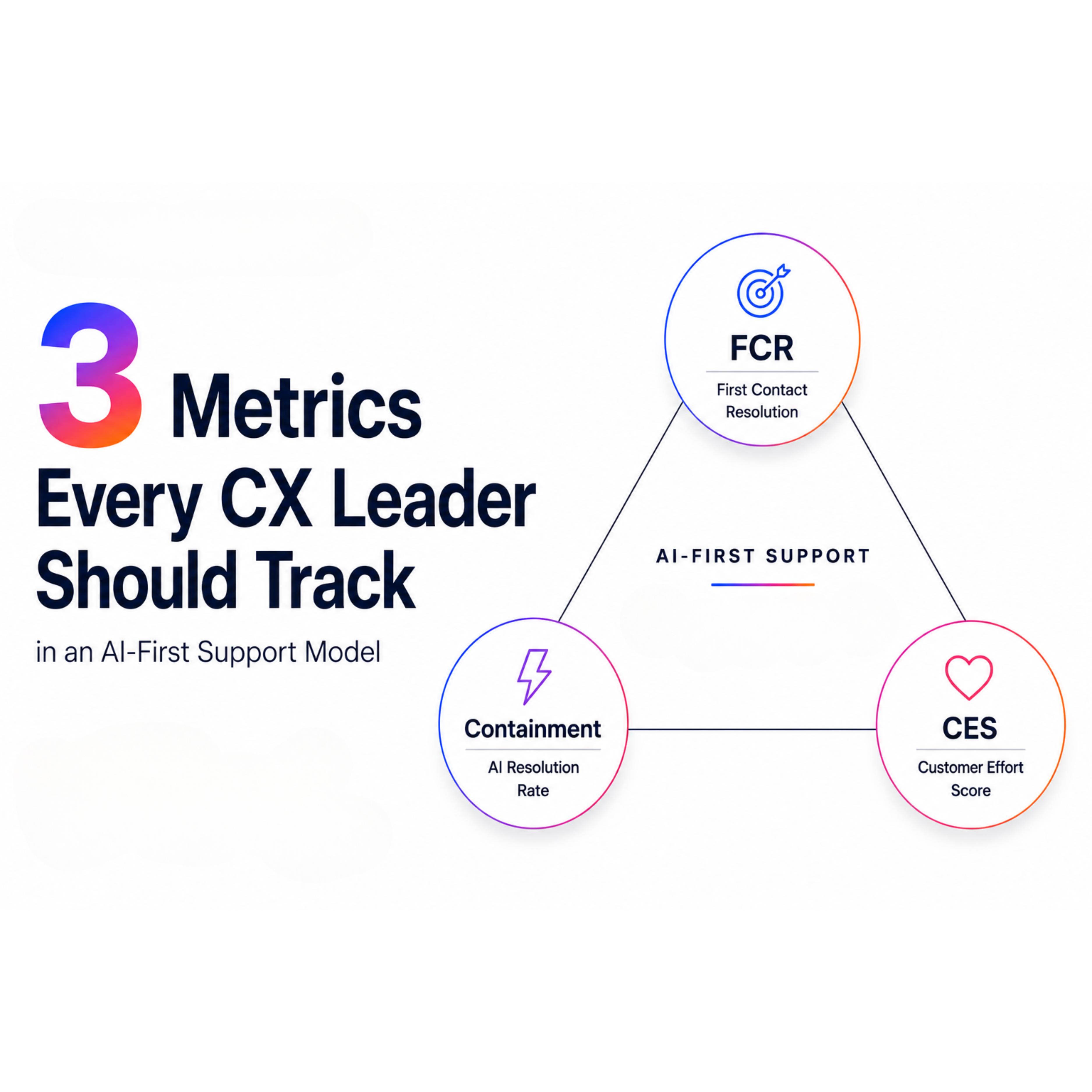
3 Metrics Every CX Leader Should Track in an AI-First Support Model
For years, customer support teams have been measured on the same metrics: Average Handle Time, ticket volume, and agent utilization rates. These numbers made sense in a world where support meant phone queues, scripted agents, and reactive problem-solving. But the world has changed — and the metrics haven’t caught up.
Today, AI companions and voice-powered support systems are rewriting the rules of customer engagement. They are not merely automating old workflows; they are fundamentally shifting support from a cost center into a value engine. When a customer can resolve a product setup issue at 2 a.m. through a natural voice conversation — without ever waiting on hold — the question “How long did the agent talk?” becomes almost irrelevant.
The CX leaders who will win the next decade are not the ones managing the most agents. They are the ones asking smarter questions: Did we resolve it the first time? Did AI handle it without human intervention? Did the customer feel the effort was worth it? These three questions map to three metrics that every enterprise customer experience function should be tracking right now.
Metric 1: First Contact Resolution (FCR)
First Contact Resolution has long been a north-star KPI in customer support, and it remains one — but for very different reasons in an AI-first world. Traditionally, FCR measured whether a human agent solved a problem in one call. Today, it measures whether the entire support system, AI and human together, closes a customer issue before it becomes a second interaction.
This matters more than ever because modern customers have low tolerance for repeat contacts. Research from Gartner consistently shows that customers who must contact support more than once are significantly more likely to churn. Every callback represents a failure of the first interaction, and in a world where AI companions have access to product documentation, CRM history, FAQs, and previous customer interactions in real time, there is almost no excuse for a second one.
Take Samsung’s investment in AI-assisted support as an illustrative example. By equipping its support systems with deep product knowledge and live CRM integration, Samsung was able to dramatically reduce repeat contacts on common appliance troubleshooting issues. The AI companion could surface the exact firmware update relevant to a specific device model, guide the customer through the fix step-by-step, and log the resolution — all without transferring the call or requiring a follow-up.
The business impact compounds quickly: higher FCR means fewer repeat contacts, which means lower support costs per customer, which means more satisfied customers who feel genuinely served rather than queued. For enterprise decision-makers, every percentage point improvement in FCR directly affects the P&L — and AI companions, by their nature, are designed to improve it.
Metric 2: Containment Rate (AI Resolution Rate)
Containment Rate — sometimes called AI Resolution Rate — measures the percentage of customer interactions that are fully resolved by AI without requiring a human agent. It is arguably the most important operational metric in an AI-first support model, and it is one that most traditional support dashboards do not track at all.
The logic is straightforward: if a customer can get what they need without human intervention, that interaction costs a fraction of an agent-handled contact. At scale, this is transformative. A support operation handling a million contacts per year does not need to double its headcount when the product line doubles — it needs AI capable of absorbing the volume intelligently.
High-value containment scenarios are more extensive than most organizations initially assume. Password resets and account authentication, order tracking and delivery status updates, warranty eligibility checks, product specification questions, appointment scheduling and service booking — these interactions represent a significant portion of most support queues, and they are exactly the type of structured, knowledge-intensive queries that AI companions handle exceptionally well.
“High containment and high satisfaction are not opposing forces. They are the hallmark of a well-designed AI companion.”
The critical caveat, however, is that a high containment rate should never be achieved at the expense of customer satisfaction. Forcing customers into dead-end AI loops to suppress escalation numbers is one of the most damaging mistakes a CX organization can make. The goal is genuine resolution, not deflection. An AI companion that resolves eight out of ten contacts completely and accurately is operationally powerful. One that forces eight out of ten contacts into unresolved AI cul-de-sacs is a liability.
Multilingual Voice AI magnifies the containment opportunity significantly, particularly for global enterprises. When AI companions can engage customers naturally in their preferred language — across Hindi, Spanish, Mandarin, French, Arabic, and dozens of others — the breadth of containable interactions expands across entire market segments that were previously underserved. For consumer electronics brands and OEMs operating across South and Southeast Asia, this capability alone can redefine the economics of international customer support.
Metric 3: Customer Effort Score (CES)
Of the three metrics discussed here, Customer Effort Score is perhaps the most underappreciated — and the one most likely to predict long-term customer loyalty. CES measures how much effort a customer had to exert to resolve their issue. Not whether they were satisfied in the moment, not whether the agent was polite, but whether the experience itself was genuinely easy.
This distinction matters because the dominant research on customer loyalty — particularly CEB’s now-landmark work on “effortless experience” — found that reducing customer effort is a stronger predictor of loyalty than delighting customers. Customers who struggle to get support do not become loyal. They become churned.
Legacy IVR systems are effort factories. They force customers to navigate branching menus, repeat account numbers, re-explain problems to each new agent, and tolerate silence while information is retrieved. Voice AI fundamentally inverts this dynamic. A well-designed AI companion greets a customer by name, recognizes their device from CRM data, understands the context of previous interactions, and begins solving the problem from sentence one — not after three menu selections and a two-minute hold.
The key drivers of low customer effort in AI-powered support include faster issue resolution without departmental hand-offs, the elimination of repetition across channels and sessions, genuinely personalized conversations that adapt to the customer’s language and technical fluency, context retention that means customers never have to re-explain themselves, and true omnichannel continuity that allows a conversation started on chat to continue seamlessly over voice or email.
CES also captures something AHT fundamentally cannot: the quality of the experience, not just its speed. A contact resolved in four minutes that required the customer to repeat themselves twice scores worse on CES than one resolved in six minutes with fluid, intelligent conversation. For CX leaders, tracking CES alongside FCR and Containment Rate ensures that operational efficiency is never gained at the expense of the customer relationship.
Why These Three Metrics Matter Together
No single metric tells the full story of an AI-first support operation. FCR measures effectiveness — did the system actually solve the problem? Containment Rate measures scalability — how much volume can AI absorb without adding headcount? Customer Effort Score measures experience quality — did the customer feel well-served?
The danger of optimizing for any one metric in isolation is significant. A team laser-focused on containment might inadvertently sacrifice FCR by closing tickets before they are truly resolved. A team obsessing over FCR without tracking effort might solve problems completely but through an exhausting customer journey. And a team chasing CES scores without attention to containment might over-invest in premium human interactions for queries that AI could have handled just as well.
Together, these three metrics form a balanced scorecard for AI-first customer support: one that measures whether the system works, whether it scales, and whether customers actually feel the value of it. Enterprises that track all three — and optimize across them holistically — are building support operations that are simultaneously more efficient and more human in the experiences they deliver.
The Future of AI-First Customer Support
Over the next five years, AI-first customer support will evolve well beyond what most organizations are deploying today. The current generation of AI companions — capable of voice interaction, real-time knowledge retrieval, and multilingual resolution — is genuinely powerful. But it is also the foundation, not the ceiling.
Predictive customer service will emerge as a defining capability: AI systems that identify from usage patterns that a customer is likely to encounter a problem before they even contact support, and proactively reach out with guidance. Emotion detection embedded in voice AI will allow support systems to recognize customer frustration in real time and adapt their approach accordingly — or escalate to a human agent at precisely the right moment. Voice biometrics will eliminate authentication friction entirely, recognizing a customer by the sound of their voice and skipping the interrogation of security questions.
Hyper-personalization will mean that AI companions remember not just account history but preferred communication style, technical sophistication, and past resolution preferences — delivering support that feels genuinely tailored rather than generically automated. Autonomous AI agents will handle complete service journeys end-to-end, including scheduling technician visits, processing warranty claims, and coordinating logistics, without a human touchpoint unless the customer specifically requests one. And continuous learning from millions of customer interactions will make these systems progressively more accurate and empathetic over time.
The CX leaders of the next decade will not be managing support teams in the traditional sense. They will be orchestrating intelligent systems, optimizing customer outcomes rather than managing agent schedules, and using data to continuously improve the quality of every interaction at scale.
The Competitive Advantage Is Already Being Built
The companies investing in AI-first customer support today are not just cutting costs — they are building a durable competitive advantage in customer loyalty, operational resilience, and brand trust. Every interaction handled intelligently is a data point that makes the next interaction better. Every customer effort reduced is a reason to return.
“In an AI-first world, the winners won’t be the companies answering the most calls — they’ll be the ones solving customer problems with the least effort, the highest accuracy, and the smartest use of AI.”
FCR, Containment Rate, and Customer Effort Score are not just metrics. They are signals of whether an organization has truly crossed the threshold from traditional support into the intelligence-driven future of customer experience. The question is not whether to track them. The question is how quickly you can start.
ZippiAI builds AI Companions for Products — delivering voice-powered, multilingual customer support for consumer electronics brands, OEMs, and appliance manufacturers.