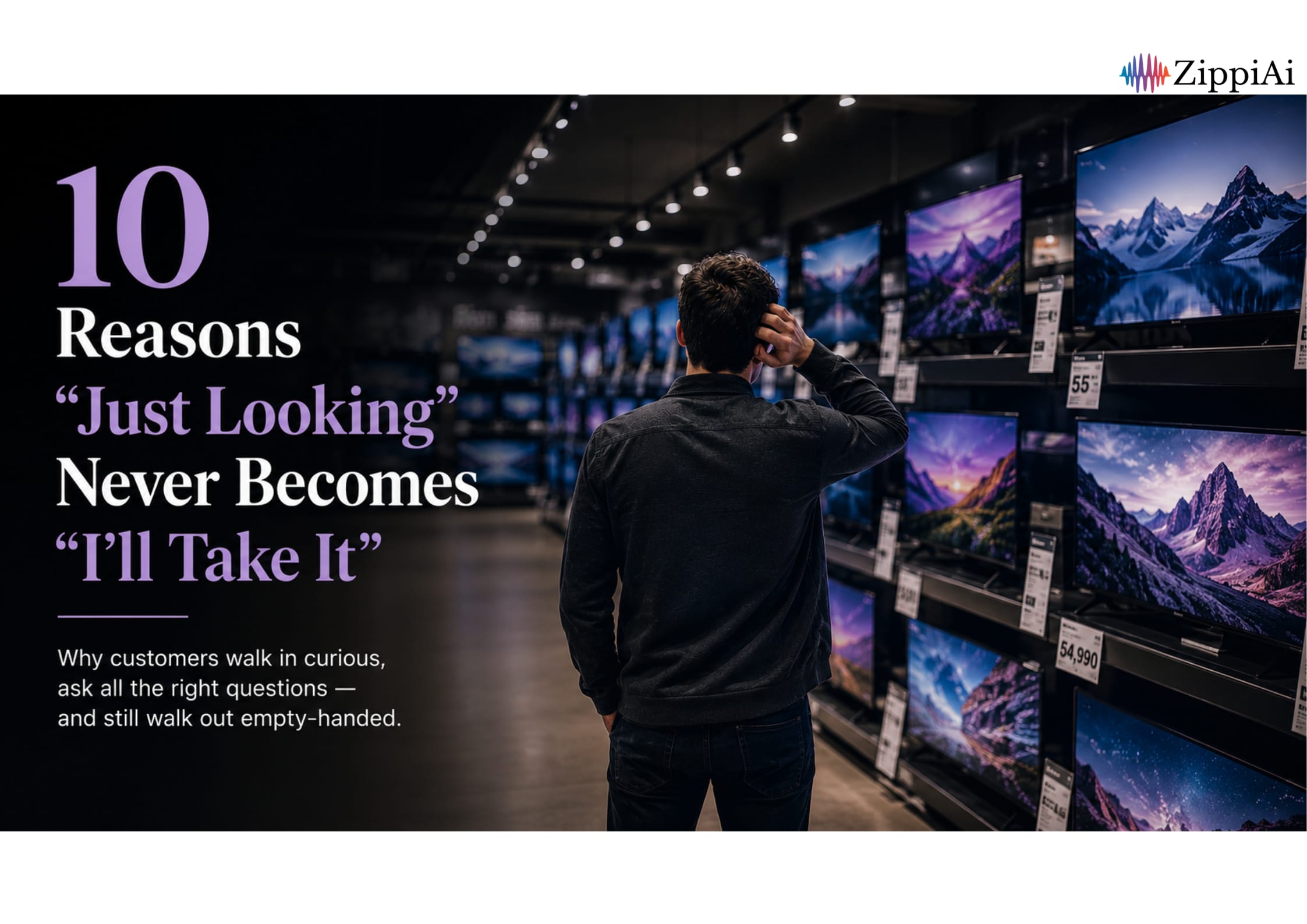
10 Reasons "Just Looking" Never Becomes "I'll Take It"
Why customers walk in curious, ask all the right questions and still walk out empty-handed.
Most lost sales don't happen because people can't afford the product. They happen because people don't feel confident enough to buy.
That's the part nobody talks about. The salesperson did their pitch. The customer nodded along, picked up the box, read the back panel, asked about the warranty and then said those four words that haunt every retail floor: "Let me think about it."
They're not lying. They genuinely intend to think about it. But thinking, in 2025, means opening twelve browser tabs, asking three people who don't really know either, watching a YouTube review from 2021, and eventually doing nothing.
Modern customers walk into stores more informed than ever and more paralyzed than ever. They've already Googled the product before they arrive. They've read the Reddit threads. They know the specs. And yet, they leave without buying. Something stops them. Not price. Not product. Something deeper.
Here are ten reasons why "just looking" almost never becomes "I'll take it."
1. The Paradox of Too Many Choices
Walk into any electronics store and count the number of televisions on display. Forty? Sixty? Each one glowing, each one promising to be the best. The customer came in wanting a TV. Now they're being asked to choose between 4K, 8K, OLED, QLED, mini-LED, and six different brands — all at slightly different prices that somehow don't feel different enough to justify a clear winner.
Psychologist Barry Schwartz called this the paradox of choice. More options don't make us feel freer. They make us feel responsible for making the perfect decision. And when perfection feels impossible, we choose nothing.
The safest choice, in the customer's mind, is to wait.
2. Decision Fatigue Is Real — and It Hits Hard Mid-Store
By the time someone walks into a store, they've already made hundreds of decisions that day. What to eat. What to wear. Whether to take the highway or the back road. The brain is not a machine with unlimited processing power. It gets tired.
Decision fatigue doesn't feel like tiredness. It feels like vague discomfort. A subtle sense that something doesn't feel right yet. The customer can't explain why they're hesitating. They just are. And so they leave, telling themselves they'll come back with a clearer head — which usually means they'll come back never.
3. The Fear of Regret Is Louder Than the Desire to Buy
Nobody is afraid of buying a washing machine. They're afraid of buying the wrong washing machine and living with that decision for the next eight years.
Regret is a powerful psychological force. Researchers call it "anticipated regret" — the fear of a future feeling that hasn't happened yet. Customers imagine themselves six months later, reading about a better model that came out the week after they purchased, or finding the same product for ₹5,000 less at another store. That imagined future pain is enough to freeze the present decision completely.
The product doesn't need to be bad. The fear of it being not quite right is enough.
4. Technical Jargon Builds Walls, Not Confidence
"This one has a 1.5-ton inverter compressor with a five-star BEE rating, R32 refrigerant, and a variable speed drive."
The customer smiles and nods. They have no idea what that means. And they're too embarrassed to ask, because they feel like they should understand by now — they've been standing here for twenty minutes.
When people don't understand something, they don't trust it. And when they don't trust it, they don't buy it. Jargon isn't informative. It's alienating. The best salespeople translate features into feelings: "This means your electricity bill drops by almost a third." That lands. The jargon doesn't.
5. Salespeople Who Push Create Customers Who Flee
There's a particular energy that good salespeople have — and it's nothing like what most customers actually experience. The moment a customer feels managed, something shuts down inside them. The slightly-too-eager approach. The way the salesperson follows them three steps behind. The pivot to a more expensive model before they've even finished looking at the first one.
Pressure doesn't accelerate decisions. It reverses them. The customer's internal voice switches from "Should I get this?" to "I need to get out of here." And the exit is always the same: "Thanks, I'll think about it."
Trust is built in stillness. Not in pursuit.
6. The Phone in Their Pocket Is a Competing Store
While the salesperson is talking, the customer is calculating. They've already pulled up the product on Amazon. It's ₹2,300 cheaper. There's free delivery. Returns are easy.
This is the invisible competitor in every physical retail transaction. The customer isn't being disloyal. They're being rational. Why pay more for the same thing? The store has to offer something the phone can't — expert advice, touch and feel, immediacy, human reassurance. If it doesn't, the customer walks out the door and completes the purchase sitting in their car.
Price isn't always the issue. Perceived value is.
7. They Came to Research, Not to Buy — And That's Okay Until It Isn't
A significant portion of customers who walk into stores never intended to purchase that day. They're in the research phase. They want to hold the product, see the actual size, feel the weight, compare the finishes. This is legitimate and smart consumer behavior.
The problem is when no one recognizes this and treats every visitor like a live sale. The customer who's researching doesn't need to be closed — they need to be informed and left with a reason to come back. When that doesn't happen, they research at the store and purchase online. The store did the work. The algorithm got the sale.
8. No Emotional Connection to the Product
Features make people think. Stories make people buy.
When a refrigerator is described only by its liters and star rating, it stays a refrigerator. When a salesperson says "This one's especially popular with families because the double-door design means kids can grab their snacks without letting the cold out of the main compartment" — suddenly it's not a refrigerator anymore. It's a home. It's a family. It's Tuesday evening and dinner is almost ready.
Customers need to be able to picture the product in their life. If they can't see it there, they won't bring it home.
9. Uncertainty About What Happens After the Purchase
The sale isn't the end. For the customer, it's the beginning of a long relationship with a product they depend on. And that relationship comes with questions: What if it breaks in six months? Who do I call? Will someone actually show up? Will the service center be three hours away?
After-sales anxiety is wildly underestimated as a reason customers don't buy. It's not the product they're unsure about. It's the support ecosystem around it. A confident, specific answer about installation, warranty claims, and service timelines removes more hesitation than any spec comparison ever will.
Reassurance sells. Vagueness doesn't.
10. They're Waiting for a Sign They're Making the Right Decision
At the very end — beneath all the logic, the comparisons, the price checks, and the second-guessing — there's a simple human desire. Customers want someone to tell them: you're making a good choice.
Not in a manipulative way. Not in the "this is our best model and you won't regret it" sales script way. In a genuine, I-understand-what-you-need, this-fits-your-life way. That moment of honest affirmation is often all that stands between a "let me think" and a "yes."
Most customers leave stores not because the product was wrong. They leave because no one made them feel certain it was right.
What Stores Keep Getting Wrong
People don't just buy products. They buy certainty. They buy simplicity. They buy the feeling that someone understood what they needed and helped them find it — without making them feel rushed, confused, or foolish.
The customer who walks in "just looking" is not a lost cause. They're a person in the middle of a decision they care about. They want to get it right. They want to feel good about it. They want the experience to match the product.
The gap between "just looking" and "I'll take it" is rarely about money or specs. It's about trust, clarity, and the quiet confidence that comes from being genuinely helped — not sold to.
Close that gap, and the sale closes itself.
If this resonated with you, share it with someone in retail, sales, or product management. The conversation about why customers don't buy is long overdue.